Showing posts with label 7 score. Show all posts

Sunday, December 25, 2016

Red Dwarf Review: "Officer Rimmer" (Series XI, Episode 4)

Merry Christmas, everybody! The reviews of Series XI, I guess, will serve as my Christmas Spectacular ThingIt's gonna go into January (I think), but given that it feels like stores have begun selling Christmas goods in August, what's the problem with going a few extra days?
A first lieutenant must keep his priorities in order, prepare for any sort of danger. Truly, Rimmer is the MacArthur of his fleet.
"Things are about to get a whole lot more Rimmery!" - Rimmer.
Airdate: October 9th, 2016
Written By: Doug Naylor
Plot: As the title suggests, Rimmer becomes an officer. He does so by saving a JMC officer that was printed out by a 3D printer. After getting this promotion, he uses the printer to make several clones. Unfortunately, like real-life printers, this one encounters some errors... a few of which are deadly.

Review:

The idea of cloning somebody isn't necessarily a complex idea. How this episode deals with it, though, is by analyzing the style of DNA reproduction by making temporary copies in a printer. It's rather horrifying, especially given that the printer is connected to a network of individuals whose genomes are available for anyone to use, regardless of their intent.

Red Dwarf, like most sci-fi tropes it takes on, puts a comedic spin on it by tying it to one of the main plot threads present in the show - Rimmer's utter failure to reach what he feels is the next class level.

On that note, anybody remember Series VIII's "Only the Good"?

Tuesday, December 6, 2016

Red Dwarf Review: "Samsara" (Series XI, Episode 2)

Lister's hair is not food. Repeat - Lister's hair is not food.
"They're dead!" "Hey, the medical reports aren't in yet. We shouldn't jump to conclusions." - Rimmer and the Cat, discussing the bodies of Col. Green and Prof. Barker. Second time Rimmer's introduced himself as a captain to dead people, by the way.
Airdate: 29 September, 2016

Written By: Doug Naylor.

Plot: The crew investigate a ship that crashed on an oceanic planet, as well as a pod that contains two deceased (read, dissolved) crew members. On that ship, they discover that the Samsara contains a karma drive - one which praises virtues and punishes callousness. The four split up - Lister has to deal with the Cat, while Rimmer and Kryten team up.

While this is happening, we learn more about the dynamic duo, who were locked in an affair with each other... and who's reaction to getting caught may have damned the ship.

Review: 

My thoughts about "Twentica" was that it was a rather solid opener to the series. While not ranking among my top 10 episodes of the show, it still managed to please me for 30 minutes. It was rather unique, but more of a way to establish something of a tonal shift. "Samsara" takes the tonal shift a bit further - rotating between two stories, past and present. Does it work? Well, let's take another analysis at this.

Tuesday, January 19, 2016

Scullyfied Simpsons: "Lisa Gets an A" (Season 10, Episode 7)

This grade is wrong, but not for the reason you might think...
Airdate: November 22nd, 1998

Synopsis: Lisa falls ill after being stuffed in a freezer to try and get some ice cream (no prizes for guessing who did it). Rather than study, she gets sucked into a video game, "Dash Dingo". She gets so hooked into the game, she forgets to read The Wind in the Willows... and comes back to a quiz on the book. ("Game over, mate!") Bart gets Nelson to hook her up with test answers, and she passes the test at such a level that the state no longer considers the school absolutely pathetic, and is willing to give them money.

Meanwhile, the aforementioned fridge-stuffer gets a pet lobster at the same supermarket. By "gets a pet", I mean Homer prevents Marge from cooking Pinchy, a lobster that the family brought for dinner.

Review (SPOILERS): Lisa Simpson is one of the more divisive characters in the Simpsons canon. This stems from the trend during the "double digit" seasons to have Lisa as the mouthpiece for the generally leftish writers, with little reasonable dissent or critique of said positions. While I see where they come from, my opinion of Lisa stems from the early seasons of the show - as it should. And while she did have moments where she seemed overtly opinionated, they were just part of her role as a wiser, more mature eight-year old, who still fell victim to the same weaknesses that eight-year olds have.

"Lisa Gets An A", surprisingly, has her fall victim to a trap that students tend to face - that of cheating. Not a bad idea, although does this episode execute it well?

Almost.

Wednesday, January 6, 2016

Scullyfied Simpsons: "D'oh-in' in the Wind" (Season 10, Episode 6)

Airdate: November 15th, 1998

Synopsis: While tracking down his middle name, Homer comes across a farm run by two former hippies, Seth and Munchie. Upon learning his middle name, and learning more about his rebellious mother and her interactions with said hippies (she painted a mural with Homer's full name), Homer takes an interest in the carefree lifestyle of hippies, and becomes one... not understanding that Seth (Martin Mull) and Munchie (George Carlin) have moderated their practices, even embracing the capitalist aspects of the 90s.

Review (SOME SPOILERS, POSSIBLY FOR OTHER EPISODES): In hindsight, maybe the 60s counterculture was too good to be true. Intended as an anti-establishment movement meant to get humanity more in touch with Earth and the fellow man, as well as generate social reforms, ironically, not only has it become the defining image of the 60s (to the point of cliche), but arguably became absorbed and moderated by the mainstream itself. Not that this was a bad thing, though. However, there is an irony here.

In many regards, The Simpsons was a counterculture in and of itself, or at least represented a counterculture. After the seemingly conservative, politically and socially stolid 80s, where American morals and archetypes were reinforced, came this show that managed to lampoon (if not subvert) every single aspect of Americana. Unfortunately, episodes like "When You Dish Upon A Star" seemed to represent the show becoming mainstream. Here's where the absorption of the counterculture in the mainstream proved to be detrimental - modern Simpsons episodes seem to run on cliche plots and hackneyed dialogue, attempting to be trendy and cool, and just coming off as a pathetic show that needs to be axed. Soon.

Now that that's out of the way, "D'oh-in in the Wind" is, in all honesty, quite an improvement over the aforementioned last episode. (That's not a hard feat, but still.)

Tuesday, November 17, 2015

Steven Universe Review: "Cat Fingers" (Season 1A, Episode 6)

If you think this screenshot is creepy... AVOID THIS EPISODE AT ALL COSTS. In fact, avoid this review. Or keep reading, whatever.
Airdate: November 25th, 2013

Synopsis: Amethyst manages to impress Steven with her shifting into a cat. Shocked by this, Steven wants to know how he can shape shift, despite Pearl's objections. Amethyst teaches him to trust his id, and Steven... manages to create a cat out of one of his fingers. Unfortunately, Steven's own id takes over, and he's unable to get rid of the cats once tied of them.

Review (SPOILERS): Glad to know what my nightmares will be about for the next month or so.

Ah, yes - "Cat Fingers". This was the creepiest episode of Steven Universe amongst fans for quite a bit, and has only been surpassed by the likes of "On The Run", "Keeping It Together", "The Return", "Jailbreak", "The Message", ah, hell, the fact that this was scary at one time shows just how slow this show was to really start burning the oil.

Still, this episode is incredibly creepy - surprisingly so, even. Let's put the obvious aspect of the creepiness this way - cats aren't supposed to be scary. They're supposed to be cute, huggable, and relieve any situation of any stress present. This episode... doesn't use any of those aspects of the "kitten" cliche. Not by a long shot.

Saturday, October 10, 2015

Steven Universe Review: "Together Breakfast" (Season 1A, Episode 4)

The Together Breakfast - so awesome, it defies physics! (Image screencapped from the Steven Universe wiki.)
Airdate: November 11th, 2013

Synopsis: The short story: Steven makes breakfast for himself and the trio. Hilarity ensues.

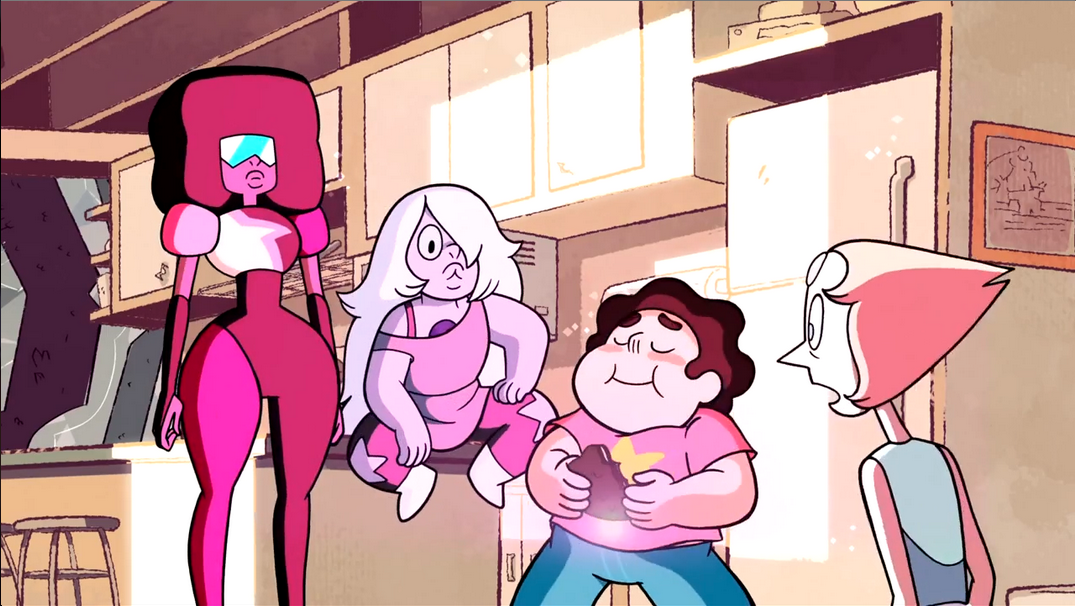
The long story: Steven makes breakfast since all the other Gems aren't around. He manages to construct what is, in his mind, the perfect breakfast - literally well balanced, in fact. However, nobody really wants to (or is able) eat it with him - Garnet has to torch a poster, Pearl wants to be alone to fix up her room, and Amethyst just wants to gulp it all down. Kinda strange, then, when said breakfast comes to life and threatens to destroy them.

Review: Show of hands - who wants iHop now? Second show of hands - who has a fear of iHop now?

OK, really... just to let you know, this review is going to be somewhat shorter than usual, partially because this isn't the most memorable of episodes. It seems inconsequential at first - Steven cooks breakfast, tries to talk to the other gems, and said breakfast tries to destroy them all. In fact, it almost seems like a Regular Show episode. (Worth noting, I don't really watch that show, so no, that isn't getting reviewed anytime soon.)

And let's be real here - this episode's plot is pretty "color by numbers", with not a whole lot of real twists. Steven wants to please the gems, and almost dies doing so. So, not a whole lot of points for originality.

However, within the plot, there's actually more than a few things in here that help build the overall show even further.

Sunday, September 27, 2015

Gravity Falls Review: "Roadside Attraction" (Season 2, Episode 16)

Airdate: September 21st, 2015

Synopsis: The Mystery Shack gang (bar Wendy, plus Candy and Grenda) go on an RV trip to sabotage competing tourist traps. While on the trip, Dipper tries to get over Wendy by "homing his craft" on other girls. (And no, he doesn't use the "mesmer-stare", thankfully.) This does not bode well when Candy confesses that she's developed a crush on the geek... and only gets worse when Stan gets kidnapped by a giant spider who led him on... that he tried to lead on.

Review (SPOILERS): Back in February, "Northwest Mansion Novella" aired. Given that there was something resembling ample notice regarding the controversy (i.e. the promo containing the two relatively close together), I was able to post an editorial regarding the somewhat controversial ship, and comment on the episode's effectiveness as a launcher afterwards. In the former, I made a comment regarding the fact that Candy and Dipper (or CanDip) had no traction, and didn't seem to have chemistry... mainly because none of the writers really put the two together outside of quick gags.

Here, CanDip is set sail... in an episode that, in deep contrast to "Northwest Mansion Whozawhatzit", is a deeply lighthearted episode... and far less consequential to the overall plot. In fact, I think it's the episode most separable from canon since "Boss Mabel".

Monday, September 7, 2015

Steven Universe Review: "Cheeseburger Backpack" (Season 1A, Episode 3)

Now available in Vegetarian and Turkey styles.
Airdate: November 11th, 2013

Synopsis: The local mailman, Jamie, delivers Steven his package from "Wacky Sacks". As the title of the episode suggests, it's a backpack that's shaped like a flippin' cheeseburger. Good timing, too, since the Gems are about to go on a mission. You see, the Gems have to place a Moon Goddess Statue at the top of a Lunar Sea Spire soon, or else the whole thing will disintegrate. With Amethyst's vote of confidence (under the pretense of "education"), the other Gems let Steven and his cheesy backpack come along with them.

Hilarity ensues.

Review (SPOILERS): We're still in the early stages of Steven Universe, where characters hadn't been too fleshed out yet, comedy was the centerpiece, and the animation was more likely to be off. This episode is a prime example of just how far this show's quality shot up in a short time, yet from the other end.

That's not to say it's a bad episode - it's just not one that seems like it has a whole lot going for it, at least in terms of "favorite episode" lists. However, it does have enough to make it a good third episode.

Monday, August 10, 2015

Movie Review: Star Trek III: The Search For Spock

(Note: yes, you read that correctly. It's Trek III, not Trek II. For more on why, I refer you to here.)
A dying planet. A fight for life. The Search for Spock. (Poster by Bob Peak, taken from Wikipedia)

Released: June 1, 1984

Synopsis: The Enterprise comes back from it's most recent excursion beaten down, and with chunks of it's crew - including it's science officer - dead. As the NCC-1701 dry-docks, Dr McCoy begins acting bizarrely. Meanwhile, Lt. Savvik and David - Kirk's son - have been left behind to orbit the Genesis Planet, and discover that Spock has been revived as a child. Due to some proto-matter in the Genesis device, the body of Spock has mere hours to live. Unfortunately for them, they wind up intercepted by Kruge (Christopher Lloyd), the commander of a Klingon vessel, and are kidnapped.

Kirk and Spock's father, Sarek, deduce that Spock transferred his katra - living spirit - to McCoy, and that McCoy must give Spock's body the katra soon, or else the doctor will die. One problem, though. Not only is Spock's body on the Genesis planet - where discussing the planet is forbidden due to the political controversy involved in it's creation - but the Enterprise is not being refit, and is due to be scrapped.

Determined to save the lives of his best friends, he and a skeleton crew commit Grand Theft Starship, taking the Enterprise out of dock for what is certainly her last tour.

No prizes for guessing what crew meets what commander.

Review (QUITE A BIT SPOILER-Y): Star Trek II: The Wrath of Khan is my all-time favorite movie. It's themes are a loving tribute to the works of Shakespeare, while still forming it's own identity. It's characterization is beautiful. It's special effects are great, considering the $10M budget. It's dialogue is fantastic. And the ending... so poetic, so tragic, so beautiful.

It's almost impossible to top Wrath of Khan... even with a direct sequel. So, how did they do?

Saturday, July 25, 2015

Steven Universe Review: "Gem Glow" (Season 1A, Episode 1)

This transformative moment in Crystal Gem history... brought to you by Ice Cream. Maybe.
Airdate: November 4th, 2013

Synopsis: It has not been a good day for Steven Universe - his favorite brand of Ice Cream sandwiches, Cookie Cat, have been discontinued. Not helping matters is the fact that he can't harness the powers of his gem - even when his fellow Gems are under attack by Centipeetles. However, when eating some of the last Cookie Cat ice creams available (Amethyst stole them, and Pearl paid for them afterwards), Steven's gem seems to activate. With the three gems giving different techniques on how they activate their gems, Steven believes that his technique is to eat the Ice Cream... which comes at an interesting time, given that the Mother Centipeetle attacks the quartet.

Review (SPOILERS)Steven Universe begins on a note that, while at first casual, has many of the hallmarks of a pilot - near-universal character development, and elements of world-building, but also a simple, breezy plot, to get the most casual viewers sunk in.

As far as the rest of the show goes, though, it's a pretty mild affair.

Saturday, March 21, 2015

Scullyfied Simpsons: Season 9, Episode 25: "Natural Born Kissers"

Nothing like your 11th anniversary to realize you have old cake in the fridge.
Airdate: May 17, 1998

Synopsis: It's Marge and Homer's 11th anniversary. However, recent events (such as having their anniversary dinner at a family restaurant) have them fear that the zest in their marriage has run out. While trying to get a motor for their freezer, the two get stuck in a muddy driveway in the middle of farm country. Hiding out in a farmhouse, the risk of the farmer catching them inside reignites the fire in their relationship, and the two realize that their relationship reignites when the risk of being caught in compromising situations increases.

Meanwhile, Bart and Lisa find Abe's old metal detector. After finding tons of junk, the two eventually locate a copy of an alternate ending to Casablanca. Let's just say, the ending isn't what one would consider a classic.

Review: Shorter review than normal here, because there isn't too much to dissect. Earlier episodes did the "zest in love life" plot better, added more pathos, more character development, and were funnier. It seems like this episode was just done to appeal to fanservice, as well as see how far the writers could "push the envelope", and didn't really bother to make that many other benchmarks in terms of quality.

It's amazing that, by the standards of the show, this was one considered one of the more "risqué" episodes. Remember- around this time, "South Park" was stretching the boundaries of what a cartoon could show. It seems like this episode was constructed as a response- a more risqué, envelope pushing episode. Nowadays, it's a relatively tame episode. Strip away the more "edgy" content, and what you have is a rather pedestrian episode- Marge and Homer have a marriage crisis, a plot point which would be a cliche of the Al Jean years. If you want to be "edgy", at least have substance.

I don't know- maybe 12-year-old me might have liked it because it was "edgy", but with years gone by, I just feel like it's a typical Scully-era episode- decent situation, zany buildup, zany ending. It's far from the worst offender- it's still a bit funny, and characterization was pretty decent, if milquetoast - but it's not the most outstanding thing I've seen this show do.

The message of the A-plot? Don't break the law. It's too much trouble for everybody involved.

Strangely enough, I found the B-plot a bit more interesting than the A-plot. Bart and Lisa finding an old movie actually could've made for a decent A-plot in and of itself- sort of a remake of "Three Men and a Comic Book" meets "Lisa on Ice" meets "Day the Violence Died". We could've seen some great character interaction between the two- something we really haven't seen all season. Here, finding an alternate ending to Casablanca only allows for enough material for a B-plot, and with what little time it's given, it's executed very well.

In fact, that plot showcases the satire aspect of The Simpsons more than the original. In trying to find treasure, Bart and Lisa come across an ending to Casablanca that is far, far happier than the one in the movie. It's pretty clear that the ending is a spoof on the strict standards set for movies well into the 70s- movies like All that Heaven Allows, for example, had to slip their depressing messages under a thin cover of "happiness". Casablanca is well remembered because it's ending wasn't happy, and it's characters didn't just stick themselves within archetypes, and the movie was more than just a simple romantic drama.

This episode also reveals, rather ironically, that a bad ending can erase a lot of goodwill that a piece of media built up prior to the climax. If there actually was an ending like that, and it got slipped in, I doubt Casablanca would be as popular as it is now. Hear me, Simpsons writers? Finish strong- otherwise, you will encounter the wrath of geeks! (Ah, who am I kidding- they stopped caring years ago.)

The moral of that story? Metal detectors are time sinks, and cliches are awful. (Al Jean musn't have paid too much attention to that last point.)

Game, set, match for season 9. Next up for our trashing? Season 10.

Tidbits:
  • I'll admit right now- the setup to the A-plot is pretty funny. Marriage in a rut, plus old cake, plus forgetting to close the freezer? Brilliant. (Just wondering- why was the fridge also open? Ah, never mind.)
  • Gil's back! Remember- he used to sell shoes? Now he sells cars... and can't do that well at all. Methinks that's going to be Gil's character- an utter failure at everything he does. He probably wouldn't have been used as much in later seasons if Phil Hartman hadn't been shot. What a shame.
  • I just love the look on Maude's face when she notes Ned's obvious golf advice. It's the face that shows, as happy as their marriage is, there's still some small differences between the two of them, rather than Maude just being a female Ned. I love those subtle moments of character... when I catch them.
Zaniness Factor: 1.5- even with the ending, the episode is still relatively grounded.

Jerkass Homer Meter: 1. In fact, I think Homer is a bit milquetoast here. Calm before the storm? I hope not. (Hint: it probably is.)

Favorite Scene: Nothing too outstanding in this episode, but I found the "Casablanca Alternate Ending" brilliant enough to get this award.

Least Favorite Scene: Let's face it- the second half of the A-plot was just an excuse to push the envelope. Oh, and Homer gets hurt a lot during that.

Score: 7. Barely. 

Now, to end the season (and other seasons of Scully's era of The Simpsons), I'm not going to do a traditional "wrap-up". Rather, I'm going to include that in a "Not Another Top (X) List" post. That post? The 9 worst episodes from Season 9.

Sunday, February 1, 2015

Scullyfied Simpsons: Season 9, Episode 23: "King of the Hill"

Airdate: May 3rd, 1998

Synopsis: After a disastrous outing to a church picnic, Bart realizes that Homer is pathetically out of shape. Homer, disappointed in himself for failing his son, decides to take up an exercise regiment, complete with trips to the "gyme" and eating Powersauce bars. Impressively, with the help of Rainier Wolfcastle, he manages to build up sizable muscles within two months, albeit developing a bit of ego along the way. One particular trip to the "gyme" has Homer and Bart meet up with representatives from Powersauce, and Bart convinces Homer to take up on an offer to climb the super-tall Murderhorn. The executives sponsor the trip along the way, turning it into an ad campaign... even having sherpas help Homer.

Review (SPOILERS): Watching these past few episodes has been like a pendulum. We had "Trillions" show the assassination of satire, "Girly Edition" show the brilliant satire formed over the previous eight seasons, "Trash of the Titans" show Homer get a job and act like an asshat all the way, and this episode, actually extending pathos to Homer. Is this the last we'll see of a sympathetic Homer? Who knows? (Hint: probably.)

This episode chooses to look at one of Homer's defining physical features- his rotundness, and how it contrasts to society's expectations of machismo. It's a bit strange that, given the relative zaniness of these past few episodes (Cuba? Really?), this episode actually has a somewhat realistic portrayal of Homer's health and what happens when he exercises- even though he gets muscles in two months, he's still not presented as fit. The way this episode portrays his strives to get healthier actually makes you feel for Homer through the entire episode.

Unlike future episodes, which will show Homer become macho thanks to the power of a dietician, this episode shows the fraudulence of certain "schemes" to healthy living- that is, food in "health bar" form. This actually shows a realistic viewpoint of that scheme- eating the bars seems to motivate Homer. When the rug is pulled out from under Homer (mmm... Chinese newspapers), he rejects the Powersauce Executives fears that he won't make it to the summit... only to embrace it after almost dying.

He only truly abandons his quest after he learns something about his father. Why? Eh, it's a plot arc introduced in the third act. I would've placed something a bit earlier, but it fit with the pacing of the episode. Still, he realizes that there can be no greater shame than what his father did, and that whatever he does is still more dignified. I won't spoil it, but it is a pretty dark moment.

While Homer does dip in a little bit of "Jerkass" territory here, it's relatively minor and somewhat excusable- with the pathos built up, it's understandable why his ego inflated a bit after gaining some muscle. Likewise, the resolution of the plot is a bit... strange. Still, somewhat alleviated by Homer's pathos.

Getting back to the macho part, this episode does take some shots at society's expectations of macho-ness via Wolfcastle. The muscles. the feats of strength. Yet, he won't do the impossible in real life- climb the Murderhorn. Granted, his reasoning is justified, but still. The Gravity Falls episode "Dipper Vs. Manliness" did a similar episode 15 years later- one that criticized masculine stereotypes. Being that "Manliness" happens to be one of my least favorite Gravity Falls episodes, I find it strange how an episode from the waning years of The Simpsons can best a similar episode of a show which might be my all-time favorite.

Not much to say here, really. A good episode, albeit relatively unmemorable (except for "gyme"), probably the last before Scully's brand of Simpsons fully takes over.

Tidbits
  • The mockery of advertising is brilliant. The Powersauce executives are annoyingly hysterical- they're more callous about death and danger than Mr. and Mrs. Valentino! 
  • This just in: Powersauce is amazing!
  • Note to self: always use "gyme".
  • Apologies for being out these past couple of weeks. Writers block, plus new blog, plus a new semester, does not motivation make.
  • One last note: this will likely be the last blog post under the current URL. At the latest, as of the posting of my review of the next Gravity Falls episode, "Northwest Mansion Noir", the URL will change to starbug1729.blogspot.com. I would preemptively bookmark it, if I were you.
Favorite Scene: Every scene with Abe and McAllester is brilliantly done. Nothing says character development like those scenes.

Least Favorite Scene: Eh... can't name a scene that stood out for it's weaknesses. All of them were necessary to the plot.

Jerkass Homer Meter: 1.5. Homer gets a bit more aloof and callous when he gets fit, but it's immediately balanced out by the pathos in the episode.

Zaniness Factor: 2... mainly for the last three minutes.

Score: 7.

Update- 2/2/15: Not related to The Simpsons, but I've just learned/realized that Geraldine McEwan, who played Cassandra in Red Dwarf, died recently. In tribute of her, I post this quote from "Cassandra":
Cassandra: All of the Canaries will be dead within 1 hour, except for Rimmer...
Rimmer: YES!
Cassandra: ...who will be dead in 20 minutes.

Wednesday, November 12, 2014

Scullyfied Simpsons: Season 9, Episode 19: "Simpson Tide"

Airdate: 29 March, 1998.

Synopsis: Fired by the Nuclear ("nuc-u-lar") Power Plant again, Homer sees an ad for the US Navy reserve, and promptly signs up. His friends are convinced enough to sign up, as well. During the "war games" scenario, he is placed on a Nuclear ("nuc-u-lar") sub. This can only end well... by which, I mean can only end in a Cold War revival, complete with the Soviet Union.
"We thought you broke up!"
"That's what we wanted you to think!" 
Cue the Berlin Wall and the threat of nuclear ("nuc-u-lar") disaster!

Oh, and Bart gets an earring to try and be cool. Apparently, The Bartman is "so 1991". Homer is not pleased.

Review: This episode is an unusual one, indeed. It's one of those episodes that I should loathe, but can't bring myself to hate.

Let's face it: it has several traits that would become cliches of the Mike Scully era of The Simpsons. Homer gets a new job, becomes supremely respected by his boss (more than he should), has to take charge because his boss is an idiot, his friends join into his "scheme of the week" for no reason, the plot goes from "relatively grounded" to "street-rat crazy" at the flick of a switch, the progression barely makes any sense, and Homer gets off with a slap on the wrist for almost plunging the world into chaos. Oh, and the show dabbles in meta humour.

Sounds like a trainwreck, eh?

Actually, it's pretty entertaining- one of my favourites from this (so far) otherwise mediocre season. As I implied in my "Principal and the Pauper" review, I am willing to reduce the weight of an episode's flaws in my views if the episode is hilarious enough. Now, there are exceptions, but this episode is not one of them.

I think that most of the reasoning behind this episode's "funniness" would have to be rooted in the showrunners for this episode- Al Jean and Mike Reiss. While their era was not as zany as, say, the David Mirkin Era, they did distance the show somewhat from it's domestic origins, allowing for wider swaths of characters to engage in a plot, as well as characters engaging in less "home-based"/more community-based plots. This episode just happens to take it to the extreme end of the spectrum, dwarfing Mirkin's era in terms of zaniness.

If anything, I'm a bit disappointed that this episode didn't try harder with the jokes about the USSR- a sign of things to come. They could've made jokes about the fall of the union, the failures of central planning, etc. Instead, they chose to colour by numbers- the Berlin Wall, Lenin, the tanks in Moscow, etc. Still funny, but a bit of a low-ball.

Also, while Homer does progress quite far up the command for an "average joe", this episode doesn't exactly use him as a "pain magnet"- a trend in Modern Simpsons episode where Homer would suffer injuries, and walk away unscathed, going on to act like a Macho Sue idiot all the way. Plus, he does give up some of his hubrus- he realises that Bart getting the earring may have saved him in the long run.

That, and it does make note of the influence of the media on modern conflict, what with the Channel 6 News Report pretty much calling Homer a traitor and a communist, followed by the USSR coming back. Or maybe it was just coincidence. Eh, still interesting.

Oh, and character? A little bit mixed. I mentioned Homer and his dubious promotion to captain already. Captain Tenille? Funny, and pretty well developed, what with the relatively small amount of time given to the character. Bart? His rebellion by getting an ear piercing seems to harken back to his rebellious character, yet here, he seems desperate to "follow the leader" of Milhouse... yet failing epically. Maybe it's a sign that his "rebel" character would be phased out in favour of a more "desperate" character. Sad. Still, the other characters did seem to be more than pawns in the adventures of "Captain Wacky", as some have called post-classic Homer.

Let's see- if there were a few changes to the plot, if maybe some of Homer's "progression up the ziggurat" was toned down, if maybe the flow was a bit better, if maybe characters didn't materialise out of thin air (Smithers, anybody), this episode would fit pretty damn well in the Mirkin Era. Instead, I have to take it for what it is- a Scully-era episode (not a Scully episode) that worked pretty damn well, given that I laughed through it. A rare breed, indeed.

Tidbits:

  • OK, there was one clever reference to the USSR. When talking about his experience in the Navy, Abe references JFK, and a comment that made his sailors think that he was disloyal to the Allied Forces. Who else was president when tensions between the USSR and the US reached a fever pitch?
  • "I'd like to get my ear pierced?" "Well, better make it quick, kiddo. In five minutes, this place is becoming a Starbucks!" That is all.
  • Admittedly, I can excuse some of Homer's promotion by a line that indicates that Captain Tenille has some Navy-related trauma.
  • One last note: due to personal matters, the review for "Blendin's Game" might not go out until next weekend. I apologise in advance for the long delay.
Favourite Scene: OK, I'll bite: the scene with Tenille getting shot out of the torpedo tubes was a brilliant piece of dark comedy.

Least Favourite Scene: I still can't buy the Village People actually singing "In The Navy" while on a submarine, plus Smithers, plus the sub going underwater while they're all still outside. That was too dark for me.

Score: 7. Again, given mainly for the comedy.

Saturday, October 11, 2014

Red Dwarf Review: Series X, Episode 2: "Fathers and Suns"

Airdate: 11 October, 2012
AHHHH!!! DATA DOCTOR FLASHBACKS! GET EM OFF! GET EM OFF!
Synopsis: Every year, Lister sends a Fathers Day card to himself, then proceeds to get wasted so that, when he sees the card on Fathers Day, he has no recollection on what he put in it. With Rimmer telling Lister that he's a pathetic father, and with the help of the Medi-Bot, Lister decides to give himself tough love. Meanwhile, Rimmer and Kryten install a new computer, Pree. Compared to Holly, Pree has extreme intelligence, yet with a twist: her mission is entirely tied to the crew, such as repair standards and final destinations. This proves problematic when, in Lister's act of tough love to himself, he resigns his position on the ship.

Oh, and Kryten is also wondering... is a table game that he played with various vending machines the night before offensive?

Review: This was a bit of a strange episode to organise my thoughts about. While the episode had a plot (two, even) that could've fit solidly in the first two series, the end result felt a bit more awkward than it should have been.

This episode is a follow-up on "Ouroboros". In hindsight, I think "Ouroboros" was the moment when Series VII heavily lurched toward it's negative reputation. ("Beyond a Joke" sealed it.) This episode decides to focus on how Lister tries to act like a parent to himself. Thankfully, the result here is much better than the result seen in "Ouroboros"- Lister actually acts on the fact that he's the victim of the "grandfather" paradox. I have to say, the scene where Lister keeps popping in the tapes he made the previous night, with his "father" self in sync with his "son" self, is brilliant in both comedy and character. It shows that, as slobbish and as seemingly unmotivated as Lister is, Lister actually wants to improve- he's just a bit too comfortable in his current state. That, and it's probably the best gag in the show since at least "Cassandra".
"From now on... Red Dwarf is run by Pree!"
Speaking of which, I think the "Pree" plot could best be described as "Queeg" meets "Cassandra", with doses of "White Hole". I think that's why that particular plotline felt a bit off- I think Doug was midway through writing the episode, noticed the similarities between this and "Cassandra", was short on time, and decided to rip off "Queeg", because who gives a damn about creativity anymore? Hell, if The Simpsons can rip of plotlines for 15 straight years and still get nominated for Emmy awards for 14 years after the sell-by date (not saying I like that theory), Red Dwarf can ape from two episodes once and get away with it.

In that plot, we get more of a view into Rimmer's latent control freak tendencies, sexism, and attempts to conceal both. The execution seemed a bit broad, but it is a reminder that, as much as we feel for Rimmer after we see his family life, we have to recognise that he's a git.

Pree, as a character, is actually pretty interesting. After learning that she did a shoddy repair job, she reveals that she takes her personality from the crewmen. Lister was able to predict what he was going to do with the tapes. Rimmer orders everything done, no matter what the cost. Kryten holds everything up to the letter of the law. The Cat is very strategic. Pree holds all of these characteristics- a gestalt, if you will. (And yes, I recognise that this is similar to "Legion".)

The C-plot did split opinion when it first aired, with several reviewers claiming that it toed the line of good taste. In hindsight, I actually sort of liked it for what it was- a running gag that also exposed some aspects of the Red Dwarf universe. I did like how Red Dwarf presented itself as the anti-Star Trek; in Trek, racial issues are seen as largely cosigned to the 20th century, with racism symbolically represented with episodes such as "Let This Be Your Last Battlefield". Red Dwarf, though, still has racism as a question in their universe- that, and the characters are certainly at least a bit ignorant. Fits well with the more cynical universe of Red Dwarf. Yes, it did reach points that bordered on awkward and dated (Taiwan Tony, for one). However, the pay off manages to fuse all three plots in a manner that's pretty damn creative.

So far, Red Dwarf X is holding it's own; not outstanding, but not wretched. Will the next episode break the streak of good episodes? Who knows?

Tidbits:
  • This episode also gives some more input as to what happened with Rimmer between "Only the Good" and "Back to Earth", as we learn that he knows about Lister's parental situation. So, he does have some knowledge of the events of Series VII and VIII.
  • Craig Charles actually had the flu during filming of the "tapes" sequence. Strangely enough, this made his scenes during and after Lister's rant more convincing.
  • If I had to choose between the Medi-Bot and the Data Doctor... I'll choose the Medi-Bot. Simply because I never want to so much as look at Series VIII. Ever.
  • It's worth noting that this is the first episode of Red Dwarf since VIII to take place entirely on Red Dwarf itself (barring a brief sequence where Lister is jettisoned out of the ship). If VIII is ignored (which it should be), then it is the first episode since "The Last Day" to take place entirely on the small rouge one.
  • One more note: I will be putting off my review of the Gravity Falls episode "Little Gift Shop of Horrors" until we get closer to halloween.
Favourite Scene: Tapes. Sequence. Excellent acting, excellent writing, excellent timing... excellent.

Least Favourite Scene: I'll admit- Taiwan Tony was a tiny bit dated.

Score: 7.5. It would've gotten an 8.5 if it wasn't so derivative.

Saturday, October 4, 2014

Red Dwarf Review: Series X, Episode 1: "Trojan"

Airdate: 8 October, 2012

Synopsis: The scouters aboard Red Dwarf pick up a derelict ship, the Trojan. Despite the derelict being unworthy of flight, this ship fascinates the crew, who are still stuck on a ship "slower than the speed of dark". After Rimmer fiddles around with a quantum rod, the Trojan comes in close contact with the Columbus III. The hologram on that ship is Howard Rimmer. Yes. Rimmer's brother. Already dejected from failing the Astro-Navs again, Rimmer's resentment fills up his hard drive, causing him to suffer a crash. After being cleared of some of the "malware", he realises he has two options- fess up to his failures, or lie to his brother.

No prizes for guessing what he chooses.

Review (SPOILER-ISH): One of the central tenants of Rimmer's character has always been the conflict between the guy and his family. It's strongly implied that, as much as he uses them as a crutch for his aloof and insensitive behaviour, that his strained relationship really did mess his psyche up. His father physically abused him, mentally abused him, his brothers tortured him beyond typical "brotherly" fights, and his mother was aloof to the whole situation, sleeping around to avoid the situation. Bringing Rimmer's supposedly more successful brother to the centre of an episode- the premiere of the first "regular" Red Dwarf episode in 13 years, mind you- was, in hindsight, a bit of a daring manoeuvre. Does it work?

Mostly.

Being that Red Dwarf has traditionally made Rimmer the centre of an eccentric ensemble, it's no surprise that he gets the first episode out. They had no choice- if they had focused on, say, Cat, enough viewers might have been alienated to put the franchise in danger. In some regards, the writers had no choice but to play it safe. Yet, again, they also took the risk to introduce us to Rimmer's brother, Howard. That was cool of them.

This episode drops a damn huge revelation on us concerning Howard, however. Let's just say that he never really was the person he was hyped up to be. Yet, he also manages to do something that would take a lot of chutzpa for anyone- especially Rimmer- to do. What we see is the impact Rimmer's poor childhood had again, through Howard. His life was a lie- what makes you think Rimmer's other brothers were failures themselves? Did Rimmer's parents lie to him in a failed attempt to motivate Rimmer to succeed? Or were they too selfish about their own failures, that they would lie to their own son? It's a pretty interesting twist.

Rimmer's character, yet again, has to be reset somewhat, just to give a feel to potential new viewers. As such, as awful as we saw Howard in previous episodes (and as awful as Rimmer said he was here), we saw Rimmer return the favour. Granted, it blows up in Rimmer's face, but Rimmer still pulled a cruel manoeuvre. In fact, in my first ever edition of "Not Another Top X List", I placed Rimmer's betrayal of his brother at #1. Yet, if what we know about Howard is true... he totally deserved it.

The big problem with the episode lies with Lister and his stupid call centre plot. Really, there was little humour to mine from it. Granted, I loved Kryten freaking out at the call centre operator. However, it also forces him to act way out of character in order to resolve the plot (here's a hint- it deals with jumping at the risk of getting hit with phasers.)

After two series of slapdash/nonexistent comedy and a series that tried too hard to be a postmodern drama, the comedy here is back to form. It's not really too hysterical- there's not too much character comedy here- but I'll take this far over "Beyond a Joke" any day of the week. Favourites of mine include the "Trojan moving gag", the "orange glow paint" joke, Rimmer's interactions with Trojan, and Rimmer trying to revise for his test.

So, was "Trojan" worth the wait? I'm willing to say so. It's probably not too much of a masterpiece (the call centre was pretty stupid, for one), but it serves it's purpose- bring Red Dwarf back to it's roots. Driving the point home, the episode was given a generally positive reception after three series of divisive-to-scathing reviews. That's just how pleased the fans were.

Welcome back, Red Dwarf. Nice to review episodes of you again.

Tidbits

  • I forgot to mention- the acting in this episode is pretty damn good. Strangely enough, compared to the first 8 series, Craig Charles did give off a bit more of a "dramatic", toned down vibe to Lister's character. Granted, Charles does play Lloyd Mullaney in Corrie. Oh, and Lister is at least in his mid 40s (physically).
  • Like always, the Cat makes pretty much everything funny. Danny John-Jules just has that midas touch.
  • The question is- will I review Series XI when it comes out? If I'm still doing this blog (which I probably will), then the answer is a resounding yes.
  • Again, very pleased to see that the models for the ship are back. CGI? Who needs CGI?
Favourite Scene: Going to have to go with Rimmer, post resentment-removal. Lots of character comedy there.

Least Favourite Scene: Three words. Call. Centre. Plot.

Score: 7.5

Wednesday, September 24, 2014

Red Dwarf Review: "Back to Earth"

Airdate: 10-12 April, 2009

Synopsis: It's been nine years since Rimmer kneed Death in the pelvis on board a burning Red Dwarf. Since then, Red Dwarf seems to be back in order... albeit empty again. Holly is out of commission, flooded out thanks to Lister. Kochanski is dead, and Lister is still in mourning. After noticing low water supplies, the crew discover that a giant squid is in their water tank. Said squid is rapidly replaced by a former crewmember, Katerina Bartikovsky, who declares that Rimmer's run time is to be terminated due to his incompetence, and that Lister (with the help of some squid DNA) is to go back in time and repopulate humanity. Learning that they inhabit an "invalid" dimension, the crew (and Bartikovsky) are sent to a "real" dimension- Earth 2009, where they learn they are part of a mere TV show.

Review: Ten years is a mighty long time in between episodes- essentially, a generation change. The internet became a true necessity, the economy rose and fell, terrorists committed high-profile attacks in London and the Northeastern US (amongst other locations), London had begun to prepare for the Olympic games, there were two American presidents, the office of the UK PM changed hands, and the popularity of the Labour Party slowly cratered... amongst other events.

Once BtE premiered, it polarized fandom beyond any fears. Those that didn't love it hated it.

So, the question is, can Red Dwarf still hold it's own after a 10-year hiatus (and 15 years since the last truly great Red Dwarf episode)?

Well, let me put it this way: I liked it quite a bit more than I was expecting to. Or maybe I was so let down by shlock like "Krytie TV" and "Pete" that anything would be an improvement! More after the break!

Sunday, August 24, 2014

Scullyfied Simpsons: Season 9, Episode 17: "Lisa the Simpson"

Airdate: March 8th, 1998

Synopsis: After Lisa fails to solve a brain teaser that the other students got instantly, a series of unfortunate events (such as a diorama) begin scaring Lisa about the quality of her intellect. Grandpa eventually tells her of a trend that various Simpsons have, where their intellect declines over the years, calling it a "Simpson Gene". A frightened Lisa tries to fight back against the suspected decline, only to fear that she's becoming lowbrow and low class.

Review *SPOILERS*: Is it possible for one scene to make an entire episode just seem mean spirited? It's a pretty damn hard feat, but "Lisa the Simpson", which seems almost perfect, just contains one little scene that drives me spare.

Yes, it's a Lisa-centred episode. Some of the best Lisa-centred episodes focus on her relationship within the clan of The Simpsons: she's probably the most down-to-earth of the group (Homer and Bart are Homer and Bart, and Marge is occasionally spacey). Even so, she's portrayed as a bit aloof, reserved with her intellect in the dumb town of Springfield. So, an episode that seems to take her down a peg, show that she can still fall into the same traps as the rest of the town? That's a good idea. We did see her take up an angry activist moment in "Lisa the Vegetarian", where, in pushing her beliefs via pig-napping, made her little better than Homer "You don't Win Friends With Salad" Simpson himself. However, to see this normally intellectual character enter a period of self doubt, thanks to family coincidence... that makes for an entertaining episode.

And, for the first two and a half acts, it is a very gripping episode. Having Lisa deal with the fact that she might be damned to the same amounts of insolence as the rest of the town of Springfield is surprisingly emotional. You see, she was slipped up by a mere brain teaser that the rest of the kids got in seconds. Is she overanalysing the brain teaser? Maybe. It's Lisa Simpson: in a town of the average joes, she's the one who looks too deep. That's a really creative way to show that a character that's normally an ace has her human flaws.

Led on by, well, Grandpa about Simpson history, and taking on more activities with Homer and Bart (i.e. watching When Buildings Collapse on FOX), Lisa enters a state of resignation, submitting her brain to "one last meal" at the Springsonian and the Jazz Club. It's actually pretty damn emotional to see her try and fight, even going as far as to make a futile attempt to plea to the town of Springfield to increase their horizons. She knows it's futile. She just needs to be heard.

Of course, there was the ending, where Homer brought in several of his relatives. It rotates between hysterical and heartbreaking, depending on what mood you're in. The context of Lisa's worst fears being confirmed truly contrasts with Homer's relatives describing their careers as "I step in front of cars and sue the drivers" and "Jug Band Manager". It's truly fantastic.

Then the real ending happened, and I wanted to chuck my DVD out.

You see, Homer only brought in the Simpson men: the women are fantastic successes. Why? Well, apparently, it's genetic: the "Simpson Gene" is apparently only carried on the Y chromosome- thus, only men are affected.

Translated: Simpson men are damned to be idiots, while women? Raging successes.

Let's ignore that Herb Powell was a raving business success, who was only failed by the American buyer, who wanted everything in a car, yet wanted the design to take few risks (and to not have it cost $82,000). Let's ignore that Abe is a fantastic military strategist, who is held back by his senility and his desire for a more active life getting the better of him. Let's ignore that Homer has flashes of great intelligence, only held back by a weak upbringing and years of alcohol consumption. Let's even ignore that Bart could be fantastic at anything- he merely has a short attention span, and maybe some other learning disability. Nope, now all Simpson men are just idiots.

Yup, this is apparently a happy ending. Why? Lisa was validated.

Look, I'll get this off my chest right here and now: I am pretty pro-feminist (and yes, I am a male). I support equality of the sexes, I am in full support of the advancement of women's rights, the objectification of women or the reduction of them into mere tools drives me up the wall, I feel that America (and to only a slightly lesser extent, the rest of the world) has quite a way to go when it comes to neutralising sexism and objectification of women, and I feel that there is a dearth of well-written characters who are also female.

That being said, in my opinion, this ending is less a testament to feminism and more outright misandristic. Basically, Homer and Bart are openly told that, because they are male, they are basically damned to failure. Yet, this is a happy ending. Why? Well, Lisa can solve the damn puzzle.

I'm just hoping that the scientist that told Lisa about the truth about the gene was just lying to save Lisa's sanity. Even then, the fact that the men are presented as idiots yet the women are presented as successes still comes off as a bit sexist, eh?

It's a sign of things to come: later seasons of The Simpsons have had troubling gender-related politics, trying to present itself as a feminist, progressive show, when in reality, creating female characters that were little more than props or satellites for other characters.

I don't really know what to think about the main plot. As good as most of it was, the ending just threw me. Even the very last two lines in the episode can't really save the ending for me. It's a major dent in the quality of the episode.

Oh, and Jasper gets trapped in a Kwik-E-Mart freezer, and Apu and Sanjay turn the mart into a tourist trap. It's a pretty good subplot.

Tidbits:

  • This is the last episode not produced by either Mike Scully or Al Jean in some form (until Season 22-ish), and the second to last one for four years to not have Scully at the helm. Eh, can't always end on a high note.
  • This episode was also written by Ned Goldreyer. He did some work on the UPN's adaptation of Dilbert, one of the most underrated animated sitcoms of all time.
  • Give Dan Castellaneta credit: the fact that he can do all of the voices of the male Simpsons? No wonder why he's getting about $300,000 a year as of late!
  • Oh, and I apologise for the long hiatus/vacation. For some reason, I just couldn't motivate myself to put something down on paper... that, and there was that Simpsons marathon on FXX.
  • Also, Gravity Falls will be back in September. I might be able to put down a few more Scullyfied Simpsons episodes... or, I might return to Red Dwarf. Maybe.
Jerkass Homer Meter: 1

Zaniness Factor 1.5. Having an old guy survive a freezer? Eh, not stupid.

Favourite Scene: Lisa's plea to the town of Springfield really shows the power of the writing this show once possessed. It's gut-wrenching, funny, awesome... it's just sublime.

Least Favourite Scene: The ending, though, just left an awkward taste in my mouth.

Score: 7

Sunday, August 10, 2014

Scullyfied Simpsons: Season 9, Episode 16: "Dumbbell Indemnity"

Airdate: March 1st, 1998
Insert joke about remembering when The Simpsons used to be good here. (Image stolen from Wikipedia).
Synopsis: Moe has been entering into something of a depression: he has no companionship. While initial attempts at getting Moe a girlfriend at a local discotheque ultimately prove fruitless, he winds up meeting Renee (Helen Hunt), a local flower seller, and the two hit it off. When Moe wants more money to keep treating her to the finer things in life, he decides to commit insurance fraud... with Homer as his "guinea pig".

Review: The Mike Scully years of The Simpsons featured some awkward character development. As our primary characters were either phased into the background or turned into wacky, centre-of-the-universe type characters, the secondary characters were seemingly fleshed out to try and show more than just their identifiable features- Mr Burns and Ned Flanders, for one, were seemingly transformed into characters with hidden hearts of gold, or ones that had deep-seated "white-bread" lives. However, the scripts were haphazard, and the characters lost a lot of their humorous traits. In effect, the characters flattened as the show slowly transformed into one that wouldn't be out of place on a cheesy saturday morning cartoon. (I kid: at least some saturday morning cartoons around this time had well-written characters!)

It didn't hurt Moe Syzlak as bad (initially): it would be understandable to see his deep-seated loner tendancies, and try and show why he keeps failing to make friends or find romance. Again, this would degenerate as the scripts became more haphazard, but it's more tolerable here.

This episode's main hangup is that, for all it tries to paint Renee and Moe in love, this episode's heart is still connected to Homer. He starts the episode with the unnecessary water heater incident, and is the right-hand man for Moe, through the rest of the episode.

The problem with this is that it does not lead to a whole lot of development for the character that's supposed to be in love with Moe, Renee herself. What is her character, anyway?  Sure, she pity-dates Moe, then falls in love with him on a more genuine level. Apparently, it's his "insecure, sweaty charm". It's implied a few times that she's only in love with him because he spends money on her, yet also has standards on how said money is procured.

However, as an individual, we learn little, if anything, about her. Her character pretty much revolves around Moe. We don't learn anything about her as a character, what her background is, what her quirks are. She's just a prop- she's the raison d'etre for the insurance fraud scheme that Moe and Homer commit.

I think, to provide an accurate comparison, we have to take a look at another "love interest" for the show: Jessica Lovejoy, from "Bart's Girlfriend".
Ah, when one-shot characters had deep character development in the span of 22 minutes. (Image taken from Wikisimpsons).
In that episode, Jessica begins something of a relationship with Bart over their skirting of authority- in this case, the church. That episode gave us a look at some aspects of Jessica's past, her present standing, how she is able to manipulate anybody and everybody, and how she pushes Bart to her limit. Given that she's a one-off character, she's given as much depth as the time allows.

Here, Renee just exposits the relationship between the two. (This will be a problem in later seasons: exposition will trump actual storytelling). Again, she has no backstory, no flaws... she's just there.

Now, Homer and Moe's scheme, I can buy. While some would criticise a paring like this as just another example of "Homer buddies up with some character to get him into the centre of the plot", I can see why Homer became Moe's right-hand man. Homer always seemed just a little bit closer to Moe, compared to the rest of the patrons at the bar. In a more immediate sense, Moe's sense of self-doubt could explain why he felt he needed to throw money around to keep Renee happy.

Homer is, well, something of his jerkass self. He gets into the centre of the plot, winds up as part of a zany scheme, survives the impossible, and winds up in a violent rage (for a few seconds). It's a bit more tolerable here: he was pressured by Moe into the zany scheme, and Moe's betrayal would drive anybody a bit loony. Still, it was a bit over the top.

Humour is really a mixed bag. Most of the jokes that work are the quick comic gags, such as Snake trying to rob Homer's car, everybody's reaction to the bar tabs being called in, and of course, "Hail to the Chimp". The good character comedy is more sparse, although I think this is because one of the characters is practically a prop. Even then, Renee gets one or two decent lines. ("Yes, Moe. I'm going to find corpses.") There were also jokes that dragged on for just a bit too long, such as the "car drowning" scene. Once was fine. Twice, enough. Three times? A bit too much.

I don't know: it's not really a memorable episode. It's got the good, it's got the bad, it's got the Jerkass Homer, it's got some Moe character development, but it's really just... alright. Maybe it's just dragged down by Renee's bland character, but still.

Tidbits:

  • It's worth noting that, around the time of this episode's production, Helen Hunt and Hank Azaria were dating. The two were even married for about a year.
  • While the disco scene was alright, I was thrown off by Otto being there. What, was he reluctantly there on a date? Did he get roped in some other way? 
  • This episode was written by Ron Hauge, who wrote "Miracle on Evergreen Terrace" (which was also not memorable) and would later write "Mayored to the Mob". My expectations aren't exactly high.
Jerkass Homer Meter: 2, but only for his getting into the centre of Moe's plot and surviving seemingly impossible injuries. He's actually relatively mild: it's the more outlandish tendencies that got to me. Who knows: maybe I'm preparing for the worst.

Zaniness Factor: 1.5. The only thing remotely zany in this episode was the car's plummet in the ocean.

Favourite Scene: A great bit of physical comedy occurs when Homer has to bail out of Moe's car. He rolls out, and thanks to a rock, winds up back in for....

Least Favourite Scene: ...the plummet into the ocean. Went on way too long. Second place is the infamous boiler incident. Cut both of these down, and the writers could've put in some good Renee character development.

Score: 7, mainly because of the quick comedy. I'm feeling generous.

Saturday, July 26, 2014

Scullyfied Simpsons: Season 9, Episode 14: "Das Bus"

Airdate: February 15, 1998

Synopsis: While on the way to a trip to the Model UN conference in Capital City, the kids from Springfield Elementary wind up in a jam after a grapefruit-related brake failure drives the bus off of a bridge. With Otto floating away ("ZEPPELIN RULES!"), the kids wind up trapped on a deserted island. A combination of the island's lack of resources and their lack of survival skills scuttles their attempts at civilisation, and the kids have to live off of the snacks from the bus. All the while, the kids become suspicious of one another.

Meanwhile, Homer, inspired by Flanders's internet enterprise, decides to start his own internet business... despite knowing nothing about the internet. Thus, we take a look at the rise and fall of Compu-Global-Hyper-Mega-Net.

Review: I had to read Lord of the Flies during High School. (Thank you, New York State.) For those that haven't read the book in a long time, the book focused on a bunch of British students getting trapped on an island after their plane goes down. Their connections to civilisation falter, and the kids become more and more savage.

I have to say, watching this episode after thinking about the book, I was a tad bit underwhelmed.

"Das Bus" seems like it was trying to be more of a send-up to Flies, which is alright, except, as others have pointed out, it tends to play to the beats of the novel a bit too closely. The Simpsons is best when it adds twists to the source material. Outside of the ending (which I'll discuss below), the episode tended to match word-for-word the novel. Kids try and form own civilisation after getting trapped on island, yet wind up becoming more and more savage and brutal.

This episode does take quite the stab at the United Nations, as, at the meeting, we see the kids bicker over the relationship between each other, setting the tone for what they would do without supervision from adults. Once they get stranded on the island, they begin looking at their self interests. Fighting Milhouse for the "food" is a collaborative effort, but in the end, the kids want their own instant gratification. Meanwhile, Millhouse, one of the remaining "civilised" students, winds up acting like a jerkass to Lisa and Bart, asking them to carry him to safety, and repaying them by abandoning the two after crossing the cliff. Is it symbolic of international relations within the UN, and providing a message about the flaws of the organisation? Or am I looking too much into this episode? Given Scully's legacy amongst the general public, I lean somewhat to the latter.

Either way, I think if the episode focused more on UN satire and less on ripping off Lord of the Flies, this might have been more enjoyable... a little bit.

The ending of the plot is actually pretty decent. While the reveal of "the monster" is a bit too in step, it actually does lead to a very interesting twist- one that plays off of the kid's instant gratification and one that is a direct stab at Lisa's vegetarianism. I also think the ending ending was a bit of a stab at the ending of Lord of the Flies. Normally, I hold Simpsons episodes that have haphazard-esque endings in a low light. Yet, here, I kind of liked it, given the source material.

Character in the A-plot seemed a bit uneven, yet I can somewhat pass it off, given the stressful situation they're in. Some of Lisa's dialogue might seem off given her normally intelligent nature, but it also helps reinforce that she's still a second grader. Bart's dialogue also seemed to show that there are flashes of brilliance in him, yet it is also balanced by his naiveté.

Plot "B" mocks the dot-com bubble just around the time it was, well, bubbling. Homer sets up a business with no knowledge of the industry, acts like an idiot, is somehow able to buy advertising (albeit on, apparently, Voyager fansites), and, when it comes time to sell, he gets trashed... rather literally, in fact. ("I didn't get rich by writing a lot of cheques!"). Sure, it's a prototype of the "Homer gets a new job and acts like a jackass" plot that would become the centre of season 10. However, I must admit, it was pretty damn funny. By far my favourite piece of dialogue would have to be between Comic Book Guy and Homer, as CBG wants faster internet.
Comic Book Guy: "I'm interested in upgrading my 28.8 kilobaud internet connection to a 1.5 megabit fibre optic T1 line. Will you be able to provide an IP router that's compatable with my Token Ring Ethernet LAN connection?"
Homer: [Stares for a few seconds] "Can I have some money now?"
Overall, while a bit of a disappointment compared to what I was expecting, it was still a pretty decent episode. Maybe my expectations were too high. I'll give it the benefit of the doubt.

Tidbits:

  • Some fans on the internet have complained that Bill Gates, who briefly appeared at Homer's business, voiced himself, claiming that celebrity guest voices helped kill the show. Hank Azaria actually voiced Gates.
  • This episode was written by David S Cohen. It would be his third-to-last script under the title: after the Writers Guild unionised, he was forced to drop the S from his title, and instead put an X for his future scripts, including the pilot to Futurama, which I think is surprisingly underrated in the science-fiction world.
  • The resolution to Otto's C-plot is pretty damn funny... it involves Chinese fishermen and slave labour. "I think I'm gonna like it on this boat!"
  • Worth noting that the Model UN was also given a brief shoutout in "Lisa the Drama Queen", where the meeting goes awry due to the lack of certain representatives... in that case, Lisa. Strangely enough, that episode was also a parody of another piece of media- there, it was the 1994 film Heavenly Creatures. Much like this episode, it's less of a parody and more of a beat-by-beat retelling. It was a pretty weak episode, especially by the standards of the classics.
Jerkass Homer Meter: 2

Jerkass Homer Moment: Homer came off as quite a bit of a jerk to Marge, between stealing her ideas without giving her credit, ignoring her, and telling her to get out when Gates arrives to make himself look good. It's a bit annoying.

Zaniness Factor: 2.5. An episode of this calibre was always going to be "out there". It does pull back on the slapstick, however.

Favourite Scene: LOVED CBG's attempts to boost his internet speed... via Homer. Pretty much sums up Telecom companies.

Least Favourite Scene: Milhouse abandoning Bart and Lisa after swinging over the ditch rubbed me the wrong way. Milhouse is many things, but a jerkass he is not.

Score: 7.

Friday, July 18, 2014

Red Dwarf Review: Series VIII, Story 2: "Cassandra"

Airdate: 11 March, 1999
"The rest of the series will be held in low light by the fandom, except for "Pete Part Two"... which will cause people to contemplate cancelling their TV licence."
Synopsis: Lister gets the crew to sign up for the Canaries, thinking that the Canaries are the prison choir. To their disappointment, they're the prisoners that get sent on the most dangerous missions, the assumption being that they will die. Whilst on the mission, they come across a sentient computer, Cassandra, who can predict the future. She's especially good at predicting the deaths of the crewmembers, saying that they will die within 1 hour, with the exception of Rimmer ("YES"), who will be dead in 20 minutes.

Review: One would think that the pathetic excuse of a series premiere would signal that the rest of the series was just a massive time sink. Actually, that's only partially true.

In fact, this episode was good... almost great, in fact!

I've said it before and I'll say it again: there's no such thing as pure perfectionism. In my review of "Back to Reality", I never said that the episode was flawless. I said it came very close, but I also said that I don't believe in pure perfection. This episode basically takes a look at that viewpoint and asks: is that correct? After all, Cassandra has the ability to predict the future with a 100% success rate. She's able to predict the demise of the crew... sort of. As the episode goes on, we find out that the Canaries are pawns in Cassandra's game... possibly. Her screwy (in a good way) wording of the scenario helps confuse the crew, driving Rimmer mad. It's pretty damn interesting, with the twists and turns keeping the viewer sucked in. It almost feels like I watched an episode from Series IV... almost.

You see, while this episode is good, the very best episodes of Red Dwarf had just a few more complexities that added to character. For example, "Thanks for the Memory", despite it's lack of a "traditional" antagonist like Cassandra, helped develop the relationship between Lister and Rimmer, as well as their characters, in such a strong fashion. This episode, while good, is still somewhat more shallow than what would be done in Series II or III. But hey, small victories.

Despite more of a focus on plot, there is still quite a bit of good character comedy and development. Putting Rimmer with what was essentially his replacement was a strange manoeuvre, but it worked. This also added a second layer to the new Rimmer's character, albeit one that's more subjective: did Rimmer intentionally break the pipes whilst stuck with Kochanski? If so, he's a perverted jerkass who deserved to be harpooned. If he didn't... he's still a pervert, but he's not completely depraved. I did like how Lister reacts to the truth about Cassandra. Needless to say, it's a pretty good reflection on his character: he might not be too bright, but his moral centre is strong.

Really, the biggest problems with this episode come in act 1. Holly has officially been derailed from just senile and a tad bit loopy to a total idiot. Sure, 200 years alone will do that to a computer, but still. It was better when we saw him have some sense of depth. Oh, and he gets nothing to do anymore. Sure, I should be used to that (the computer wasn't in Series VI and most of VII), but still. If you're only going to make him an idiot, why bring him back? There's also Kill Crazy, who, while getting a few funny lines here and there, will (if I can recall) become one of the most annoying characters in Red Dwarf history.

Humour is alright, for the most part. The damn "canary choir" joke, though... Remember when the Cat, Lister, and Rimmer could make singing funny, and when Doug Naylor could time it perfectly? Remember that?

Even with this episode's faults, it's hard to fathom another episode in this series that will match it. It actually feels like a classic episode. While it might not be as fantastically constructed as, say, "Quarantine" and "Polymorph", it's still a damn good episode.

Tidbits:

  • Need I say that the acting is still top notch? Even in poor episodes that I've reviewed, I have not seen any of the actors put out a wrong foot.
  • Technically, this episode was premiered on 7 March, 1999, NOT 11 March. The reason? KTEH-TV, a PBS affiliate in San Jose, chose to send the entire series out on that date. (For those unaware, PBS is sort of like the BBC. However, programme schedules are far less centralised: thus, affiliates have more control over timeslots and airdates for non-news programmes). However, I am going with the BBC Two broadcast dates.
  • If you know Greek mythology.... this episode becomes more brilliant.
Favourite Scene: The scene where Lister confronts Cassandra. It's three minutes of television perfection.

Least Favourite Scene: Lister, Kochanski, Cat, Rimmer, and Kryten should never form a choir group. Ever.

Score: 7.75.