Saturday, November 16, 2013

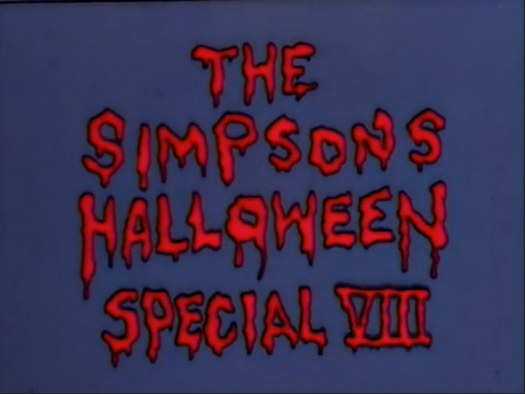
Scullyfied Simpsons: Season 9, Episode 4: Treehouse of Horror VIII

Airdate: October 26, 1997

This might be the start to the most infamous era in Simpsons history (this is Mike Scully's first episode at the helm), but this is not a bad episode at all. THOH was actually pretty good right up until the show made the shift to HD.

Like my review of "Bottomless Pit", we will go segment by segment. Like always, SPOILERS!

First Segment:

After Mayor Quimby goes too far with his jokes about the French, the aforementioned French decide to do the logical thing... and nuke Springfield to a crisp. Homer survives because he was in a bomb shelter he was looking to buy to save himself. Homer is stunned by the fact that he is the last human being alive, but begins partying like it's the end of the world (pun intended). However, mutated Springfielders show up to try and create a utopian society without past mistakes... meaning that Homer is toast.

The first segment is probably my favourite segment of the episode. To an extent, it reminds me a bit of Red Dwarf (average joe schmoe is the last person of his kind). Homer's celebration of his freedom reminds us of the human id; we act on the first opportunity. However, the scene where he cries over his family really show his heart of gold... something that would be quite a bit less visible over the coming years. And must we mention Comic Book Guy's words as he realises that he will be the centre of the nuclear explosion?
(Almost deadpan) "Oh, i've wasted my life."
Just... awesome.

Second Segment: Fly vs. Fly

Homer purchases a matter transporter to make getting to the fridge that much easier, amongst other things. Having been refused access to the transporter, Bart sneaks downstairs in the middle of the night to test it out, and realises that if two living beings are granted access to the machine at the same time, their physical features swap. Bart tries it out with a fly, but winds up becoming a fly with Bart's head, while the fly reappears with Bart's body.

Probably my least favourite of the three, this still contains many a laugh due to it's shoutout to The Fly and the amount of physical comedy. Plus, why else would somebody use a matter transporter? To do simple tasks, of course! Still, the family holds on to the idiot ball rather firmly, as they think that Bart's head is just a fly, and that it is a phase. Also, Homer chasing Bart around the house with an axe? While it's funny, it also shows the earliest signs that Mike Scully was taking Homer to strange new places.

Third Segment: Easy Bake Coven

It is the late 1690s. Sprynge-Fylde is undergoing a nasty witch hunt, with few spared. Goody Simpson becomes the victim of the next cull. She winds up facing the ultimate test of witchcraft;
"You sit on the broom and we shove you off the cliff. If you're innocent, you will fall to an honourable Christian death. If you are, however, the bride of Satan, you will surely fly your boom to safety. At that point, you will report back here for torture and beheading."
They push her off a cliff... and are proven right. Marge goes back to her cavern, alongside Patty and Selma. They decide to go out and capture some kids. In the process, they start Halloween.

Another great one, although HΩmega beats this out by a slim margin. It's funnier if you read The Crucible. I had to read that in school; pretty good. Really, it's if they took Springfield and threw it back 300 years, with almost perfect recreation. Bonus points go to the town hall meeting, which will leave almost everybody in stitches.

Overall, a pretty awesome THOH. There seems to be very little concern about the future of the show, right? Well...

Score: I've decided that THOH episodes will not receive a score, nor will be counted in seasonal wrap-ups. They would be at the top of the list of best episodes of the seasons, so I might as well just review them without a score.

Speaking of score, I will be adding extra indicators to Scully-Era Simpsons.

Thursday, October 31, 2013

Scullyfied Simpsons: Season 9, Episode 3: "Lisa's Sax"

Airdate: October 19, 1997


Synopsis: Lisa's saxophone gets destroyed in an accident. While Lisa is mourning her companion cube, Homer recounts the time Lisa got her saxophone. Two stories are then told: the first one connecting to the second one.

In the story, a 5-year old Bart loses his enthusiasm for school because his kindergarten teacher was apathetic and callous. While talking to the school psychologist, Homer and Marge note that Lisa is gifted. With no money to afford private school, Homer and Marge worry about Lisa's creativity being channeled in the cultural wasteland they live in. Meanwhile, Bart has to deal with his depression. Yes. Depression.

Review: This is going to be a slightly shorter review than normal, partially because there is not a whole lot to talk about. This is also the last episode until season 13 that did not have Mike Scully at the helm. Enjoy it.

Why? This might be the best episode between season 9 and season 13. It actually feels like a classic-era episode, with that sense of cruelty and heart that the show demonstrated during those wicked early years. The development given to Lisa and Bart is not only brilliant, it is also quite sad. Bart was depressed by a teacher, got ignored by his parents, and became America's Bad Boy because of it. We get to see how Lisa was put down by society and class, and how she got to channel her intelligence in the cultural wasteland called Springfield.

Might I also add that the humour is on par with what one would see during the Oakley-Weinstein Era. A bit sad, given the next episode had Mike Scully take over and launch his reign of terror.

It is truly a brilliant episode with few flaws. If there is only one episode to watch from season 9, make it this one.

Favourite Scene: The All in the Family parody opening. That might be even more hysterical because of the Sheriff Lobo reference.

Least Favourite Scene: Homer and Marge not paying much attention to Bart's Depression is a bit cold of them. Granted, The Simpsons is not an overtly-sweet sitcom (at least not when this episode aired) but still.

Score: 9.

Next Simpsons review... we delve into the Scully Era. Be afraid. Be Very afraid!

Depressing Tribute Time: Last Saturday, Marcia Wallace, the voice of Edna Krabappel, went to the great comedy club in the sky. This is, of course, depressing, and has shaken the show to it's core. Al Jean has announced that the character will be retired. Gotta give Jean respect for that.

Thursday, October 17, 2013

The Red Dwarf Reviews Are Going on Hiatus.

Well, this news will make Mr. Flibble very cross.

Look, I have effectively plowed through half of the original Red Dwarf (1988-99). I don't want to go too fast in my reviews of this show. Also, I am currently a bit busy right now, and I'd figure I'd take a minor break from this show to renew my energy.

I will still update the blog with other reviews, maybe a few "Not Another Top X Lists", maybe do some other segments, just to keep the pace flowing. Still, I'd figure I'd take a break from Red Dwarf for a brief time.

So, what I am saying is that, until at least Christmas, my Red Dwarf reviews are going on hiatus. Again, I might do a few specials, and I might be back earlier, but don't count on it.

Now, about the rest of the shows I review, here is the deal.
  • Gravity Falls airs in rather decent rotation stateside on Disney Channel. So, those episodes will be easy to review. Still, once episode 20 ("Gideon Rises") is done, that show will not be reviewed until next year (because episode 20 is the end of the season, and next season will debut... next year.)
  • I own seasons 9-13 of The Simpsons on DVD, so those reviews will continue. Oh, joy. I get to watch one of the greatest shows of all time utterly disintegrate. Episode. By. Episode.

Red Dwarf Review: Series IV Wrap Up

Well, we have reached the end of Series IV of Red Dwarf. We are, in terms of series amounts, halfway through Red Dwarf's original run. (In terms of episodes, we reach the half point after "The Inquisitor".)

So, what do I think? Well, not much, other than this series was wonderful.

Sure, some episodes were weaker compared to the high standards of the golden age (Camille, anybody)? Overall, however, this season produced some wicked good episodes, including the uber-memorable "Dimension Jump". All of the other episodes, however, are very much brilliant.

As I said in my preview, this season often gets overlooked, sandwiched between the critically acclaimed series 3 and 5. This series, however, was just funny. Granted, the series began and ended with two of the weaker "classic" episodes ("Camille" and "Meltdown"), but even those episodes were very, very funny.

Like series 3, the development given to the characters is awesome. Rimmer gets the brunt of the development, however. We get to see just how deranged he is in episodes like "Meltdown", yet get to see how self pitying he is and "Justice". Making a character that is sympathetic, annoying, and funny at the same time is a hard feat. Red Dwarf simply excels at it.

The plots also got better and better, and more into the sci-fi territory. We had "Dimension Jump", which analysed the idea of alternate universes; "White Hole", which used a kooky twist on sci-fi that only Futurama could do better; and "DNA", which showed Kryten go from machine to man, with hilarious consequences.

This series is just a joy to watch. If you have iTunes cash, buy it. If you have actual cash, get the DVD. If you have a Netflix account, watch it.

Tuesday, October 15, 2013

Red Dwarf Review: Series IV, Episode 6: "Meltdown"

Airdate: 21 March 1992.

Synopsis: As Rimmer is boring the crew of Red Dwarf to death with his stories, Kryten discovers a matter transporter device in the research lab of Red Dwarf. It can convert an individual into digital information and then transmit them in the form of light beams to another point in space within 500,000 light years. The crew decide to explore the nearest planet with breathable air, 200,000 light years away. Rimmer and Kryten go first to see if the atmosphere is breathable and send the device back, but are then chased by two Adult Gappas, then taken prisoner by a gun-toting Elvis Presley and the Pope. Lister and the Cat follow but accidentally end up in what appears to be the Third Reich and are captured by Adolf Hitler, whose men take the device.

It soon becomes apparent that they have travelled to Wax-world — a Wax-Droid theme park that has been abandoned for millions of years, during which time the droids have broken their programming and gained sentience. Now the droid replica inhabitants of Villain World are waging war against Hero World, in "the ultimate battle of Good versus Evil". The evil Waxdroids use the heroes' wax to make more of their own kind. Thanks to this, the heroes are on the verge of defeat. Rimmer takes up the opportunity to turn the tide of the war.

Review: This episode gets a rather weak rap on Red Dwarf polls, as it is often cited for being too hokey and a bit unlike Red Dwarf.

And I can see where they are coming from.

Not only are there some shifts in character that are not explained well (the writers tried to keep Rimmer like a human, yet he is turned into a light bee that can practically stop him at any time), but the anti-war message at the end was pretty blatant. Not Cartoon All-Stars To The Rescue blatant, but still pretty blatant.

Does that mean this is a bad episode? Not really.

This is not an episode that will place tops on the Best Red Dwarf Ever poll, but it still is a pretty funny episode. I actually like the idea of a two-plot structure seen in this episode, as it shows what happens when the Posse are split up. The end results are hysterical.

Not only is Rimmer training the Good Wax droids funny, but it also exposes an aspect of his character. He does not like being a leader so much as he likes a desire for control. He also does not give a lot about what happens to his solders: as long as he gets the personal feel of victory, all is right in the world of Arnold Judas Rimmer. That's why he is obsessed with war: he does not like the historical aspects or the mechanics or the ethics. He likes to control. He thinks that he is leading, but he is controlling. His dialouge with the Wax Droids shows it all. Also, he has no idea how to lead anybody. "We attack tomorrow, under cover of daylight!" And that's just the tip of the iceberg.

Plus, Lister and the Cat's antics are pretty good. The scene with them in the jail cell is hilarious. There is the Cat flipping out, Lister watching the worst people come out and build gallows, and then...
They're tyin' him to a stake... it's Winnie the Pooh! [...] It's Winnie the Pooh, I swear! He's refusing the blindfold.
(after watching Winnie get executed, he simply steps down, completely fazed). That's something that no one should ever have to see!
Also, Elvis Presley as one of the good droids that kidnap Rimmer and Kryten? Brilliant! And the bad special effects of dinosaurs? Wonderful!

Of course, the critics of the episode do have a point when they criticise the "moral of the story" ending. Unlike in "Justice", where it was mocked by having Lister fall down a pipe, there was no such mocking of the moral. That's not really like Red Dwarf. When it does include a lesson, it's pretty subtle. Granted, some anvils need to be dropped, but still; a bit jarring.

TL;DR? A wickedly underrated episode, and a good closing episode to series IV.

Favourite Scene: The jail cell scene. Just, the jail cell scene.

Least Favourite Scene: The whole "moral of the week" ending. What is this, Red Dwarf, or Captain Planet?

Score: 8.

Wednesday, October 2, 2013

Scullyfied Simpsons: Season 9, Episode 2: Principal and the Pauper.

Airdate: September 28th, 1997

Synopsis: Springfield Elementary School is about to celebrate the anniversary of Skinner's tenure at the school. Skinner is surprised at the glowing tribute given to him. However, a strange man (Martin Sheen) pulls up and enters the school, and announces that he is also named Seymour Skinner. Skinner conciedes that he was an imposter (really named Armin Tamzarian) and that he took the real Skinner's identity.... and, really, describing beyond that point would just be a waste of space.

Review: Oh, boy. This episode. To many people, this episode marked the very first signs of the show's descent into hacktackularity. The plot alone is considered to be the worst one ever made up by the show.

Now, what do I think of this? Four words: bad plot, decent execution.

The idea itself just screams "moronic" right from the get-go. Really, taking a character that had been developed over the past 8 seasons, and then revealing all of that to be a fraud? WHAT THE?  To add insult to injury, this creates tons of plot holes in the show's canon. (Who was serving with Abe in "Curse of the Flying Hellfish"? What else happened with Skinner in Vietnam?)

Also, with this, we get to see the show truly use a gimmicky plot that it would often mock. Granted, unlike other examples, I can see the idea of this (even though it was a stupid idea from moment 1), as a desire to experiment with the canon of the show. However, it still is stupid, and was a sign of things to come, with lack of care for characters or interesting plots. So, yeah, this episode deserves a goodly amount of it's hate.

Where is it redeemed? Well, it's actually quite funny. I would not consider this the funniest episode ever, but there are plenty of scenes that will still elicit quite a few laughs. A few include:
  • The Road Trip to Capital City, with Agnes, Edna, the Simpson Family, Abe (also part of said Simpson Family), and Jasper.
  • "Is this the line for those who want to badmouth Sargent Skinner?" "And have 12 Items or Less!" "12, 11, 10, the man's a weenie!"
  • "The judge offered me a choice. Jail, the army, or apologising to the old man and the lady. Of course, if I knew there was a war going on, I probably would have apologised."
  • Apu not caring what Skinner/Armin calls himself.
  • "Keep looking shocked, and move slowly towards the cake!" 
Still, I can see why that this episode is quite controversial. The plot is stupid. Maybe, if they did not play it so seriously, it would work. That, however, is a failure that would also dominate later episodes, with cliches and/or stupid plot elements played dead straight. Even then, with the ending scene, they did tend to take the MST3K Mantra with this episode. However, with the fanbase of The Simpsons being as passionate as it is (seriously, log onto nohomers.net or deadhomersociety.com), I can see why they did not take kindly to this episode.

Favourite Scene (Spoiler): The very end of the episode, with the necessary deus ex machina (in which the town legally denies the real Skinner's existence).

Least Favourite Scene: The reveal of Armin Tamzarian. Except for the "move towards the cake" line above.

Score: 6.5.

Behind The Laughter (According to Wikipedia): If you thought only the fans hated the episode... not so. Harry Shearer, who plays Skinner (Our Skinner), hated this episode. Matt Groening also was not a fan of this episode. Ken Keeler, however, declared that this episode was his personal favourite to work on. I personally prefer his other works, like "A Star is Burns", "Two Bad Neighbors", "Brother From Another Series", damn near every episode he did on Futurama (such as all four series finales he did. Yes. He did all four episodes which, at the time of production, were supposed to be the end).

Saturday, September 28, 2013

Scullyfied Simpsons: Season 9, Episode 1: "The City of New York Vs. Homer Simpson"

Airdate: September 21st, 1997.


Synopsis: Barney Gumble, after being forced to stay sober for one night, goes insane and manages to land Homer's car between the Twin Towers of the New York World Trade Center. Yes. Those towers. He has to choose between picking the car up or having it towed away (i.e. trashed). Homer is sceptical about going to the city, as he had a bad experience there in the 1970s. The family go to New York, with Homer going to the World Trade Center to get a cop to unboot his car, while the rest of the clan tour NY.

The family overall has a good experience in New York, experiencing the good side of things (the top of the Statue of Liberty, a Broadway play, a carriage ride in the park, MAD Magazine). Homer, however, magnifies every single fault he has, and after missing the cop because he had to go to the bathroom at the top of the World Trade Center, he decides to drive away with the boot on the car. He manages to get said boot loose, picks up the family and speeds away from New York, with no intent to return.

Review: This episode is known for three things, two of which that would dominate the show in future episodes, and all of which could be seen as a detriment against the episode.
  • An early apperance of Jerkass Homer.
  • One of the many "The Simpsons Go To..." episodes.
  • The episode with Homer's car is parked at the twin towers. Yes. Those Twin Towers.
It's partially because of the latter reason why this episode was never aired in syndication in the New York Tri-State area after 9/11. Being that I live in the tri-state area, that means it was not until 2007 when I caught the episode on DVD.

This episode was produced for the 8th season, although it aired during the 9th. So, the only reason this is included is because it contains traced of the flaws that would dominate the episode later. The main plot is a bit thin and random, Homer is loud and quite obnoxious, he gets off with little comeuppance (although his car is trashed), and the subplot is quite meagre (although, seeing how the subplots would fall later on, this is actually rather good).

Still, this episode is actually quite funny. For those of you who do not know what New York City was like in the 70s.... think of what Detroit is like now. It was pretty bad. I could see where Homer was getting at with his refusal to go to New York. Therefore, you expect him to amplify every single negative point about New York City and his trip. I actually do enjoy the contrast between Homer's view of New York vs. the family's experience of NY. Also, you can not deny the fact that "I'm Checking In" is a pretty catchy song.

This episode is, overall, not the best episode of The Simpsons ever made. But it could be worse. In fact, the next episode is going to be quite worse.

Favourite Scene: "I'm Checking In!"

Score: 7.5

Sunday, September 22, 2013

Scullyfied Simpsons: The Fall of a TV Giant.


There is no denying it; The Simpsons has shaped American culture. It broke rules on what can be in a cartoon, it mocked everybody, it managed to merge both cynicism and sweetness within mere moments of each other (if not simultaneously), it had likeable characters, intelligent humour, and a wonderful setting. It was the very first prime-time programme I EVER watched, and I still quote various episodes to this very day.

Now, the show gets ready to enter an historic season 25. With this, we must take some time out to reflect on a show that is still shaking up norms, slashing-and-burning, making us think, and overall, bringing us strong belly laughs and warming our hearts.

I only wish that the second sentence in the previous paragraph was true.

Indeed, there is no doubt about it; at some point, The Simpsons slipped in quality. How badly it has fallen and when it slipped is up to every viewer. It is the opinion of this blogger that the show began slipping in season 9, entered freefall in season 10, and finally burned out completely in the middle of season 20.

There are various factors in the crash: running out of plausible plots, mischaracterisation, trying too hard to say relevant, etc... There are also many people to blame for this crash in quality: the less talented writers, Matt Groening, FOX, the cast, etc. etc. However, most of the hatred from the fandom is laid on the feet of one man.

Ladies and Gentlemen, I have the distinct honour to introduce you to Mike Scully.

Scully took over the show in season 9. Coincidentally, that is also when the show started to slip in quality. Now, it's hard to list every problem in minute detail, but let's go over the problems in quick succession.
  • The tight control on the storylines got loosened. Suddenly, plots were seemingly made up on the spot.
  • The nerd-humour was cut down significantly.
  • A Decline in touching moments. We went from endings such as "You Are Lisa Simpson" and "Do It For Her" to "Jockey Elves trapped in Garbage Bags" (Not kidding about the elves) and "Pirates Rob a Yacht".
  • Mischaracterisation. Often, characters would change from episode to episode. The most infamous example? Homer went from "selfish and moronic, yet lovable and somewhat down to earth", all the way to "Captain Wacky callous egomaniac". Others were changed, but Homer is the one most remembered.
    • Adding on to the Homer example, he also became the centre of the universe, and met all these celebrities, had zillions of jobs, etc. You know, your average joe!
  • Speaking of celebrities, the purpose of guest stars changed from having them voice characters created by the writers, to having them voice idealised versions of themselves.
  • Storylines that were not shifting rapidly from second to second were repeated from earlier episodes.
  • Stuff that would have been played for laughs in earlier episodes was played seriously, and vice-versa.
  • Not a single care toward the audience, if not outright insulting them.
Now, I know what you are thinking: Mike Scully is not the one man responsible for the decline of a once brilliant TV show! And you are right. In Scully's defence, many factors involving the staff caused a slip in quality. Also, Mike Scully wrote some of the best scripts in the history of the show (Lisa's Rival, Lisa on Ice, Two Dozen and One Greyhounds, Lisa's Date with Destiny).

However, Scully was the man at the top of the food chain (Matt Groening had backed off the show and was developing some office comedy that was not well liked by FOX.)

Mike could have kept a tight control on the staff and their writing/animation. He did not. And that's why Mike Scully gets so much blame. He had so much responsibility, and he did not utilise it well. That's why he gets a chunk of the blame for the show's slip in quality.

Now, here's the deal with the episodes that I will be watching. We are going to span from the first episode of season 9 all the way to Mike Scully's last episode as executive producer in season 13. This will mean that we will cover a couple of episodes directed by Bill Oakley and Joel Weinstein (who are responsible for season's 7 and 8, but also had a few holdovers). One of those episodes from season 9 under Oakley/Weinstein is considered the beginning of the show's collapse.

Will we cover any more episodes? Maybe. We might go back to season 1 to analyse the beginning of the show, season 7 to try and rebut a claim by the popular "Kill the Simpsons and Do It 15 Years Ago" blog "Dead Homer Society" that the episode "Marge Be Not Proud" marked the very first signs of decline. We might even take a look at season 25, just to see how stupid and boring it is.

But the point is, we are going to analyse the collapse of what was once the de facto king of comedy.

Wednesday, September 18, 2013

Gravity Falls Review: Season 1, Episode 14: Bottomless Pit!

Airdate: March 1st, 2013


Special Note about this review: This episode is split into a few segments, sort of like the "Treehouse of Horror" specials from The Simpsons or the "Anthology of Interest" episodes from Futurama. It's a controversial practice that many shows do, and this episode has received mixed reviews from the fandom because of it.

Due to this structure, each segment will be graded separately, and all grades will be averaged out. So this is going to be a bit of a longer review.

As always, beware of SPOILERS!

Wrap-around: While dumping stuff in a bottomless pit, Stan, Dipper, Mabel, and Soos wind up falling in said pit. To pass the time, they each tell stories.

The wrap around segment is brilliant. It ties into the science-fiction aspect of the show, and the resolution to this shows just how brilliant this show is.

"Voice Over" (Dipper's Story)

Hey, at least it isn't introduced by Mr. Freeze... as played by Arnold Schwarzenegger.
Dipper realizes that his voice is godawful and scratchy after hearing it on tape. He winds up buying a voice-changing serum from Old Man McGucket, making his voice far deeper. However, he manages to scare off many people (up to and including his own sister), and wants his voice changed back. McGucket tells him that not only did he get the wrong serum, but also, said serum expires at sundown. After he relistens to the tape, he learns that others loved his unique voice. He goes back to his old voice, although Grunkle Stan gets another version of the Serum.

"Voice Over", if analyzed correctly, shows one overlooked aspect of Dipper's character. Dipper has this desire to mature in every aspect of his personality and body. Gravity Falls is partially a coming-of-age story for Dipper. Granted, the message "you're fine just the way you are" is a tad bit cliche, but the humour in this segment helps mitigate that problem. And the ending... oh, god the ending.

Score: 8.5

"Soos' Really Great Pinball Story (Is That a Good Title? Do They Have To Be Puns, or Whatever?) (Soos's Story)
No. No, they don't.

Soos, Dipper, and Mabel are playing Pinball in the Shack's recreation room. As Soos is about to beat his high score, the three wind up entering the pinball game. The game threatens to kill the gang with various pinballs. Soos manages to go into the core of the game, and faces the reset button. Soos is now faced with a dilemma, save his friends, or his high score? He chooses his friends, albeit somewhat reluctantly.

This segment is also pretty darn great. The ending is a bit predictable, but it presents quite a bit of development for Soos. This segment represents a central part of his character: despite his childish attachment to something with little sentimental value (his high score), when faced with an ultimate decision, he will choose his friends over anything else. The fact that he takes a decent while to make his decision shows that, despite being noble at the end, he is still a child at heart, whether for good or for bad.

Score: 9.

"Grunkle Stan Wins the Football Bowl" (Stan's Story)
Only in your dreams, Stanford!
It's exactly what it says on the tin. Stan scores the winning touchdown at the Football Bowl, gets a trophy presented by a beautiful lady, football players learn that old guys are valuable, and Stan's robot thanks him.

This one is my favorite of them all. Despite being a mere 30 seconds, it reveals that, alongside his greed and callousness, Stan also has a bit of a problem with his ego, and can't write for beans. This scene managed to leave me in stitches the first time I saw it, and not a whole lot more needs to be said.

Score: 9.5 (Although those falling down the hole with him think otherwise).

"Trooth Ache" (Mabel's Story)

The title card of this segment is way too creepy. Instead, here's a screenshot.
Mabel is upset that Stan is a consumate liar. especially after he lies to Police. Mabel consults Dipper's journal to get some help for Stan's lying problem, and manages to land some truth-telling teeth. They work too well, causing Stan to tell the truth too much, such as on his taxes (he committed flaud) and reveal a ton more truths... most of them illegal. As the cops come to arrest Stan, Mabel has to lie to save her uncle.

One part of this segment manages to land it right along Soos' Great Pinball Story. It shows that Mabel, despite being quite loopy, is probably the most moral of the main cast. Think about it: Dipper will do anything to date Wendy, Soos still has childish tendencies, Wendy is a slob, and Stan's list of flaws rivals that of Bender from Futurama. The fact that she has to lie is taken as a great disservice to her morals, and she only does so in defense of her family. Also, this segment also provides some brilliant lines! "Stan is sick and needs a bear", anybody? And the ending of this one is just brilliant all around!

Score: 9.

Overall Review and Semi-pointless Tangent/Plea: Certainly, this episode is one of my favourite episodes of the show, partially because it reminds me of the Treehouse of Horror episodes from The Simpsons which to me, were always mandatory viewing. The idea of doing a trilogy of shorts is nothing new, but this time especially, it was done very, very well. Characterisation was perfect, development was wonderful, the humour was brilliant, and overall, it was just a joy to watch.

It also supports what I like about trilogy-based episodes: despite being shorter, you have more liberties taken with the characters and the setting. Therefore, creativity is not looked down upon. You can do something like a parody of the Mary Sue, satirize TV cliches, or set the characters in situations which, while not full enough to take up an entire episode, work well in 7-minute clips.

I do have to go on a bit of a tangent and make a plea/warning to the writers of Gravity Falls, however. This also concerns the connection between "Treehouse of Horror" and "Bottomless Pit". During the Mike Scully and early-to-middle Al Jean years of The Simpsons (In layman's terms, seasons 10-20), more effort was put into the Treehouse of Horror episodes of those seasons compared to the rest of the episodes. That, alongside numerous other factors (such as characterization and plot ideas), caused quite the decline in overall quality for the show. Therefore, Gravity Falls writers, remember that if you make this an annual tradition, every episode in the season deserves a large amount of effort and not just the annual trilogy episodes.

(Even the writers of The Simpsons figured this out, however, and decided to make all of their episodes have an equal amount of effort put into them. That is to say, they now decide what not-so-relevant celebrity to put in an episode, write their episodes in two shots at best, send every single one of them off to animation studios without care for quality, collect their cheques, and let the episodes air to a frustrated and ever-shrinking fanbase.)

TL;DR: This episode is brilliant, the trilogy-type structure in cartoons works when done right, and they should've canceled The Simpsons 10 years ago.

Overall Score: 9

Another pointless note: As of this episode, the cipher used at the end credits is A1Z26.
Friday, September 13, 2013

Gravity Falls Review: Season 1, Episode 13: "Boss Mabel"

Airdate: February 15th, 2013
I believe Mabel's prior experience was in the Department of Redundancy Department.
Synopsis (SPOILERS!): Grunkle Stan has been a callous and largely ineffective boss over the summer. From scamming people, to rejecting ideas for the shack, to overall being a smeghead, the crew are fed up with him. Mabel tries to add a positive aura to the establishment, but Stan refuses. Therefore, they come to a bet: whoever can make more money in 3 days wins control of the shack. If Stan loses, he has to perform an embarrassing song conceding defeat. If Mabel Loses, she has to replace her flamboyant sweaters with a t-shirt saying "Loser". Stan tries his hand by going on a show called "Cash Wheel". Mabel is in total control of the Shack, and rules on some new-age management that she picked up from a book from 1983.

Stan manages to rack up dollar after dollar on Cash Wheel, largely by being a complete and utter obnoxious jerk. Mabel, however, has to deal with Wendy's laziness, Soos's costume, Dipper's decision to bring in supernatural aspects into the shack, and the end result of mass property damage. The stress eventually breaks her spirit, and she turns into a cynical, hard boss. Ergo, she turns into Stan. They manage to make $1 (after repairs and fees). Stan comes home, and admits that during his tenure on Cash Wheel, he went overboard and lost it all. Mabel, however, concedes that Stan should run the shack over the summer.

Review: This episode aired after months of waiting. Fans were expecting something sort-of awesome as a return to the show we all loved. I was excited.... and then a tad bit disappointed at the end result.

This episode overall was a slightly dry entry back into the show. Granted, it was in the middle of the season, and it was still a good episode, but still, it wasn't my favourite by far. The plot line was somewhat cliche, with a rather predictable ending. The idea behind Dipper's capture of the monster could have made for an episode in itself, but it is regulated to an extension of a plot. Wendy's character is made into more of a callous, insensitive jerk compared to previous episodes. Granted, that fits into her characterisation of a snarky, lazy teenager, but I would not really expect that behaviour from her to her best friend. Soos does not really get any overtly funny lines, but the scene with him wearing the question mark suit is good for a visual pun.

However, this episode does have a great philosophical question, which picks up the episode's score. Is there a fine line between being a light boss and being a bad boss? Do we need stern-ness, and how much before it goes into abuse of employees? Stan toes the latter line, while Mabel goes over the former. We all know Stan is not the best boss, but maybe he knows that his employees are lazy and need more control. Therefore, he thinks he is being strict. Does he go over the line? Quite often, but still.

Speaking of Stan, he gets brilliant lines during his Cash Wheel plot, and manages to be so audacious in his behaviour, you feel bad for laughing. The ending is a bit cliche, but it is perfectly in character for Stan. The subplot, otherwise, is just a laugh riot all around!

Still, this show works better when the Paranormal aspects of the show are brought into light. This episode contains very little in the way of paranormal, and is more of a slice-of-life episode. That is this episode's biggest letdown. Granted, from the next episode out, this show goes back into science fiction/paranormal territory.

Overall, a bit of a weaker-than-expected way back into a brilliant show, but still good.

Favourite Scene: Let's just go ahead and give the award to the entire Cash Wheel subplot, as picking one scene from that subplot is quite an affront to every other scene from that subplot.

Least Favourite Scene: Wendy's manipulation of one of her best friends. Makes you wonder what Dipper sees in her. Then again, Dipper is quite manipulative himself, so that makes two.

Score: 7.25.