Hello, everybody! Time for a quick little site update!
Here's the deal- it's January, there's no more Red Dwarf episodes to watch, it's too soon to go back, no Gravity Falls episodes to watch this month, still can't decide on if I want to do a fourth show, blah, blah, blah. I'll cut to the chase- until new Gravity Falls appears, things are getting pretty quiet.
If there's still a Gravity Falls drought in February (I hope not), then I'll probably (not definitely) use that month to finish up Season 9 of Scullyfied Simpsons, do my "9 Worst Episodes" of the season, and maybe start Season 10.
Back to that fourth show- at this point, if I do it, I'm conflicted on whether to do something long-form (X-Files, Enterprise), short-form (Twin Peaks, Invader Zim), or British- where the seasons are shorter (Sherlock, Broadchurch).
Again, the review of a fourth show is still not guaranteed. If you have any ideas, request them in the comments. I just have a few requirements- either I can do a damn fine essay analyzing it (i.e, nothing like the stuff I put out in my first year), or I can blast it to high heaven (in which case, it will likely have to be short form.) I would also prefer it if your show was available via legal means- thus allowing me stable access to the program (and preventing me from having my ISP throttle my speeds, yadda yadda yadda).
Oh, and in case I do so, I'm almost certainly ruling out Doctor Who, on the grounds that a) it's been done before, and b), it would take too long.
TL;DR- quiet month, thinking about reviewing fourth show, probably not touching Doctor Who.
Tuesday, January 6, 2015


Friday, January 2, 2015
Scullyfied Simpsons: Season 9, Episode 20: "The Trouble With Trillions"
 |
| Bloggers note: FX Now showing every episode of The Simpsons isn't too bad. The crop job, on the other hand... |
Synopsis: The IRS notes some minor discrepancies in Homer's taxes. (Read: Homer waited until the last possible second, made egregious claims, stuffed them into a manilla folder, and tried to sweeten the deal with mint candies.) Threatened with five years jail, Homer instead accepts a plea- work for the IRS to capture tax cheats. One such tax cheat is Mr Burns, who the IRS alleges took a trillion-dollar bill meant for European reconstruction post WWII. However, Burns's critique of the government resonates with Homer, and the two (plus Smithers) flee. Forced to escape the country, they decide to hang out on an island... one called Cuba.
Review (SPOILERS): The IRS here in the States is a government entity that is ripe for comedy. Americans have always had a skepticism of taxes, and that lends credence to the IRS being the least-liked bureaucracy of the US government. Mocking them by being a bunch of crooked spies who manipulate the system for their own gain would've made for an awesome episode.
Unfortunately, this episode let's that potential go to waste.
Wednesday, December 31, 2014
Not Another Top (X) List: Ranking Gravity Falls Season 1

Told ya I had a New Years trick up my sleeve, didn't I?
Greetings, everyone! You're on the Geek Centre, where we're celebrating the new year by doing a bit of a countdown of every episode of one of the greatest TV shows of all time, Gravity Falls! I'm counting down all 20 episodes of Season One. Essentially, this is similar to what I did back in April, with the worst and best episodes of the season. However, this encompasses all of the episodes from Season 1. They go from my least favourite to my, well, favourite. As well, I'll be giving a one-or-two sentence review on these episodes.
I must stress that there are no "bad" Gravity Falls episodes- just weak Gravity Falls episodes.
Alright, Fallers! Let's not waste any time!
Thursday, December 25, 2014
Not Another Top (X) List: Top 11 Best Episodes of Red Dwarf (So Far)

Merry Christmas, and welcome back (again) to...
NOT ANOTHER TOP (X) LIST!
At the beginning of our Christmas Spectacular Thing, we took a look at the top 8-ish worst episodes of Red Dwarf. By the end, the questions you were asking were probably...
- "Why the hell did you not go completely mad?"
- "Why look at the bad of this show?"
- "Why was Red Dwarf still your favourite show, even after you reviewed this tripe?"
To all three of those questions, I present this list. You see, when Red Dwarf was at it's lowest, during the doldrums of Series VII and VIII, I thought back and actually asked myself these questions.
The thing is that, even with those 16 maligned episodes in Series VII and VIII, and with the more lukewarm material that came afterward, 35 of the first 36 episodes of Red Dwarf were some fantastic television. At worst, those episodes were a bit off, but not too bad. On average, those episode were some funny, somewhat deep television. At it's best? Simply put, at it's best, Red Dwarf is some of the best television I've ever seen.
Where else could you see an odious failure of a man revealed to be a man with neuroses, a man held back by the worst that life had to offer? Where else did a seemingly one-dimensional fashionista have some of the best dexterity in the history of TV? Where else could one see a loopy computer pull the occasional trick up his sleeve? Where else could a subservient robot use his order to manipulate the system, and almost crack his programming due to the surroundings he faced every day. And where else could a man who seem to be satisfied with the simpler things in life, an utterly unmotivated slob, actually hold deep-seated values, and coincide the negative side of his id with actions that make him one of the kindest people in fiction?
And what other show would pack it all in with comedy that hits both ends of the scale? Jokes about modern pop culture and sex flow into jokes about historical figures that few may have even known about.
That's why Red Dwarf is so brilliant. Through the doldrums, I never forgot about the brilliance of the best episodes.
I picked out 11 episodes that I feel are required viewing for any fan of Red Dwarf. OK, these are mainly my favourites, but you get the idea. I was originally going to do 10, but I realised that would exclude an episode that I feel needs to be on the list. These episodes are the best that Grant/Naylor have to offer. The highest parts of the list are some of the best TV I've ever seen.
Now, as with my "Worst Episodes" list, my opinions may have changed since I reviewed them, albeit not by too much.
So, here we are...
The thing is that, even with those 16 maligned episodes in Series VII and VIII, and with the more lukewarm material that came afterward, 35 of the first 36 episodes of Red Dwarf were some fantastic television. At worst, those episodes were a bit off, but not too bad. On average, those episode were some funny, somewhat deep television. At it's best? Simply put, at it's best, Red Dwarf is some of the best television I've ever seen.
Where else could you see an odious failure of a man revealed to be a man with neuroses, a man held back by the worst that life had to offer? Where else did a seemingly one-dimensional fashionista have some of the best dexterity in the history of TV? Where else could one see a loopy computer pull the occasional trick up his sleeve? Where else could a subservient robot use his order to manipulate the system, and almost crack his programming due to the surroundings he faced every day. And where else could a man who seem to be satisfied with the simpler things in life, an utterly unmotivated slob, actually hold deep-seated values, and coincide the negative side of his id with actions that make him one of the kindest people in fiction?
And what other show would pack it all in with comedy that hits both ends of the scale? Jokes about modern pop culture and sex flow into jokes about historical figures that few may have even known about.
That's why Red Dwarf is so brilliant. Through the doldrums, I never forgot about the brilliance of the best episodes.
I picked out 11 episodes that I feel are required viewing for any fan of Red Dwarf. OK, these are mainly my favourites, but you get the idea. I was originally going to do 10, but I realised that would exclude an episode that I feel needs to be on the list. These episodes are the best that Grant/Naylor have to offer. The highest parts of the list are some of the best TV I've ever seen.
Now, as with my "Worst Episodes" list, my opinions may have changed since I reviewed them, albeit not by too much.
So, here we are...
THE TOP 11 BEST EPISODES OF RED DWARF (SO FAR)
Thursday, December 11, 2014
Not Another Top (X) List: Ranking the Series of Red Dwarf (So Far)

Hello, and welcome to...
NOT ANOTHER TOP (X) LIST!
Last time, we took a look at the 8 worst episodes in the history of Red Dwarf, plus one that surpassed the 8 so far in badness that it ranked under the eight (know what I'm saying?) Since I expect the last list to debut on Christmas, I have decided to bridge the "bad" with the "good" by ranking every series of Red Dwarf so far, from worst to best. I think the start of the list is pretty predictable- it's the rest of the series that might throw a curveball or two.
In addition, I have decided to add the "worst episode" and "best episode" from the season. Here's the deal- the best episode from the best season might not (not necessarily "won't") make it to #1 on the "top episodes" list. Likewise, a "best episode" from a lower-ranked series might make it to #1 on the "top episodes list".
Oh, and none of the DVD covers featured here belong to me.
Oh, and none of the DVD covers featured here belong to me.
Enough stalling... let's begin!
Thursday, December 4, 2014
Not Another Top (X) List: Top 8-ish Worst Episodes of Red Dwarf (So Far)
 |
| Note to self: invest in Photoshop! |
NOT ANOTHER TOP (X) LIST!
Oh, and it's December! Time for our...
CHRISTMAS SPECTACULAR THING!
Over the past two years, I took a look at Red Dwarf. I've seen the highs, I've seen the lows. I've seen the best, I've seen the worst. I've seen Duane Dibbley and the Polymorph. I saw Krytie TV and the Dinosaur. I've watched the characters evolve, devolve, and everything in between.
Now, until Series XI premieres (or until I get around to re-reviewing episodes), it's the end of the road for our look at Red Dwarf.
When Red Dwarf was good, it was awesome. It's characters, plots, and humor were unparalleled in British Comedy, in science-fiction, in TV. The construction of a solid majority of the episodes is awesome, and quite a few episodes are perfection.
Yet, to say it's not perfect would be an understatement. The bad episodes of Red Dwarf ranged from duff episodes to some of the worst TV I've ever watched. Now, debate can range on if and when Red Dwarf went down the tubes, if and when it recovered, and if and when the show's legacy was tarnished by the weaker seasons.
Still, I feel fit to put in my top examples on when Red Dwarf failed to meet the high standards set by the cream of the crop... of if it just failed, period.
Now, a disclosure: this is not in the order that I graded them, nor could the episode that I may have noted was the worst episode ever at the time of review make it to #1 on this list. This is purely on reflection. My opinions may have changed since I originally reviewed these episodes, albeit only slightly.
Oh, and stories=episodes.
Ladies and gentlemen, X=8. After the jump...
THE TOP 8 WORST EPISODES OF RED DWARF (SO FAR)
Thursday, November 27, 2014
Gravity Falls Review: "The Love God" (Season 2, Episode 9)
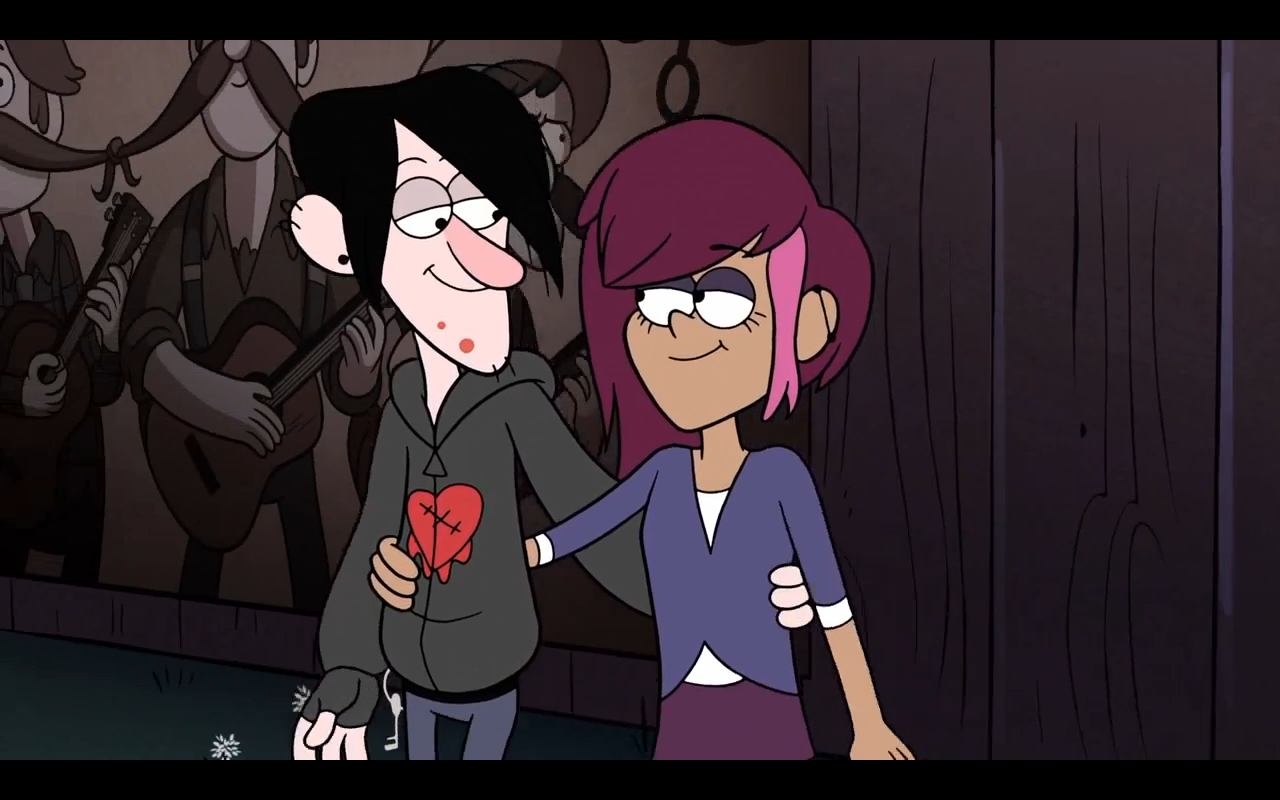 |
| Romance: the sweetest, yet the cruelest, of all emotions. |
Synopsis: Dipper, Mabel, Wendy, and the rest of the teens find Robbie in a graveyard, mourning his love life (or lack thereof). Imagining herself as a matchmaker, Mabel decides to examine the psyche of Robbie and get him into a love life. Her attempts to match Robbie up with mobilephile Tambry seem to fail, until she manages to procure (read: steal) a potion from a rocker who claims to be a Love God (voiced by John DiMaggio). The two fall in love, but also causes a row within the circle of teenagers.
Review (SPOILERS AHOY): Let's cut to the chase- this episode is among the weakest in the short history of this show, mainly because of the ending. But, let's save why for a bit later on.
This is the first episode written by Simpsons showrunner Josh Weinstein. He, alongside Bill Oakley, ran the last two "classic" seasons of The Simpsons, with episodes taking on a somewhat more "domestic" role, exploring the emotions of the characters and how they interact in the unit of Springfield. This is compared to the episodes run by David Mirkin previously, which tended to using the characters to place themselves in wacky situations that showed the problems of society, and Mike Scully thereafter, which tended more towards campy plots with characters (like Homer, Bart, Homer, Lisa, and Homer) inserted because celebrities are cool. This episode is indicative of Weinstein's run- it's by far the most "down to earth" episode this season, showing an exploration of characters within the town.
Last season, we saw a sizeable portion of the character focus go to the Pines family, with much of the rest going to the antagonists. The teenagers, the Average Joes and Janes of Gravity Falls, were often put in the background. Only Wendy and Robbie got anything approaching development; even then, they were largely denied the pathos that encompassed Stan, Dipper, and Mabel. This episode finally decides to delve into the characters of the teenagers.

The thing is, I might have been a bit too harsh in my review of "Boyz Crazy". Don't get me wrong- if Robbie meant to hypnotize Wendy, he deserved his punishment. However, if he didn't, he was merely an idiot that rivals Arnold Rimmer in terms of how pathetic he can be. He has no talent, is a coward, and tries to masquerade it with depictions of grandeur, such as faking songwriting and telling mind-erasing societies that he kicked the ass of a video game character. Beyond his image is that of a man who knows he's broken, who has locked himself out from the world.
Again, going back to "Boyz Crazy", how his breakup with Wendy affected him depends on your interpretation of the events of that episode. If Robbie meant to hypnotize Wendy, we see that Robbie made an attempt (albeit a horrible, callous, self-serving attempt) to maintain what he knew was a failing relationship, and may be regretting his deception (optimistically- pessimists may take the road that he was regretting the exposure of his failure). If he didn't, he realized that something horrible happened, he doesn't know what, and that life screwed with him.

Incredibly, Robbie's gothic tragedy contrasts starkly with his parents. Sure, Mr and Mrs Valentino appear to be chipper and happy. Yet, when you get down to it, they are almost sociopathic. They gleefully run a funeral home, smile when people appear to be on the verge of death, seem to ignore the troubles of their son... I could make a good case explaining that Robbie is rebelling against his parent's strange personalities by taking on an ironic gothic image- one that seems to rebel against society, yet one who runs on the id- this in deep contrast to his parents, who seem happy, yet seem moved by the cheques they get from running a funeral home in Gravity Falls.
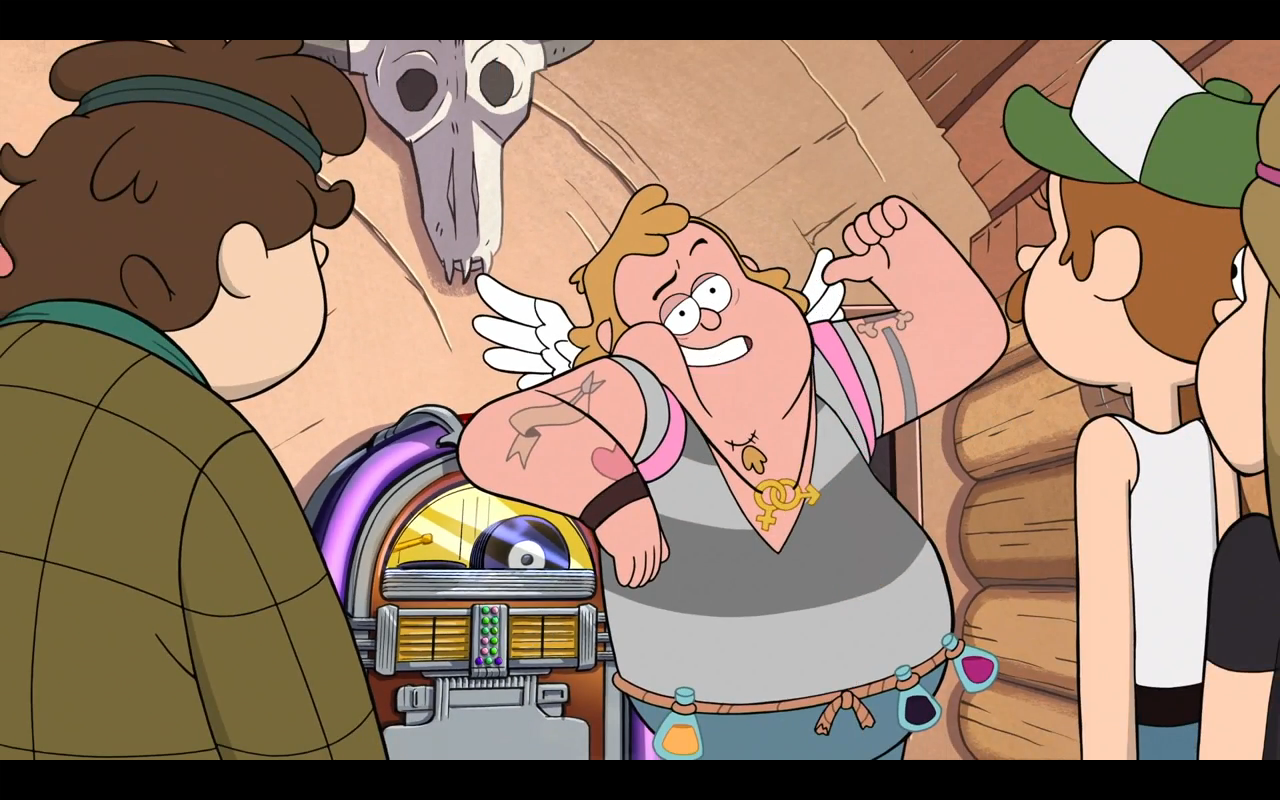
The eponymous character in this episode, the Love God, is certainly one of the quirkier one-shot characters in the history of Gravity Falls. This personification of
We also see that Dipper finally has gelled with the crowd of teenagers, often falling into the same patterns of behavior and likes as the rest. Is it genuine? Or is it a mere attempt to blend in? I'll go with the former, but it is a decent question worth asking.
Mabel's romantic perspective is also thrown in a loop. Her viewpoint on love is a series of 80s rom-com cliches. She believes that love can occur with a "love potion", that love at first sight can exist, etc. This episode challenges the love at first sight, and she realizes the power that love can have, in both a destructive manner and a positive manner.
Now it seems like I'm giving this episode praise. So why, at the beginning of the episode, did I call it one of the weakest episodes of the series?
Unfortunately, Tambry is effectively relegated to a secondary player in the game of love. Sure, we get insights into her character via her interactions with Robbie, the sarcasm and the snark. Still, she remains an enigma, trapped in the cloud of her cell phone.
This episode also continues on a trend involving Mabel-centered plotlines- a majority of them have involved romance. Hopefully, this episode puts romance in Gravity Falls on the back burner, but given Mabel's goal is to have an "epic summer romance", I doubt it.
The rest of the teenagers also seem to be but mere pawns in the romantic subplot- a pretty weak attempt to create tension. Characters in Gravity Falls normally react less irrationally to situations like this, so why does this cause such a massive rift? I can write some of it off by explaining it as the destructive power of love, but I think Weinstein just needed tension.
Ending an episode without restoring the status quo is a risky maneuver. In this instance, I can't say that the writers succeeded that well. I mean, this episode has Robbie and Tambry hypnotized into loving each other, and it's not reversed. That's a tiny bit creepy. The reason? Because the concept of a love potion is creepy in and of itself. Why?
Well, Rick and Morty actually did a damn good exploration into the drawbacks of a love potion. In the episode "Rick Potion #9", probably my favorite episode of the show, Morty convinces Rick to make a potion, in order to get Jessica to fall in love with him. After that goes horribly wrong (read, almost everybody on earth is turned into Cronenburgs), Rick blasts Morty for even asking him to create the love potion, using the logic that the concept of a Love Potion is essentially a pseudo-date rape drug- essentially forcing the victim to fall in love with the applicant.
Granted, this episode used it's version of the love potion for two external people instead of using it in a "want this person to fall for me, so I'll use a love potion on her" manner. Also, it does provide a bit of irony that one relationship was brought down by hypnosis, while another one was kicked off by hypnosis. Still, that's a bit creepy.
Also, the ending of the "conflict" was also a bit disturbing. The teens are reunited by their mutual love of seeing Thompson as the center of the world's abuse- their picking fence. That's... a bit of a tragic, awkward ending... too awkward for me.
I think the biggest problem with this episode was that it tried a bit too hard to be a comedy-focused episode. Which is fine. After episodes focusing on parental abandonment, mind-erasure, abusive relationships, body theft, extreme nationalism, dangers in romance, and the dangers of ambition, a comedy-focused episode is certainly a necessary evil. Still, it seemed to come at the expense of potential character comedy.
Again, the fact that I could analyze Robbie and his parents as deeply as I could is pretty remarkable, given that this episode was pretty weak. That, and even the weakest Gravity Falls episode is still better than 85% of television.
But, it just didn't gel fantastically.
Who knows? I just think the reason why this episode was weak was because it was Weinstein's first episode. Hopefully, his next episode makes this look like a mere outlier on an otherwise pretty good record.
Tidbits:
- John DiMaggio is pretty much perfect as the Love God. DiMaggio, for those unaware, often voices id-based characters, such as Bender from Futurama and Jake from Adventure Time. It seems like the Love God was made especially for DiMaggio to voice.
- There was actually a subplot focusing on a local indie concert, with Stan trying to get "with the kids" at the concert... for the purpose of making money. I found the send-ups to Oregon-based culture pretty damn funny, and Stan's attempts to get a few extra bucks even funnier.
- Why, when the Love God used the "visions of heartbreak past", did it only show Mabel's crushes? There might be an answer. Is it implying that Dipper never had a crush until Wendy? Possibly. Is it also implying that Dipper is on good enough terms with Wendy that being let down wasn't heartbreak? Maybe... even though "Into the Bunker" still showed him quite solemn after Wendy let him down.
- Dear DisneyXD: Pick a timeslot and STICK TO IT!
- Interesting to note that this is the weakest episode of the season, and it's the 9th episode. Last season brought us the "Time Travelers Pig", the 9th episode of the 1st season, and that was my least favorite episode of the show up to that point. I really hope there isn't a "9th episode curse" developing.
- One last note: it appears we're entering another Gravity Falls drought. No episodes are scheduled for December, so far. If anything changes, I'll edit this.
Favorite Scene: Pretty much every second at the funeral home. Brilliant character analysis and pathos on both sides of the coin.
Least Favorite Scene: The ending of both the romantic plot and the friend breakup plot. Too awkward by half.
Score: 6.5.
(Edit 21/7/15: Score was originally 7. Adjusted down to 6.5. Partially done in hindsight, partially done just to make the scores better fit the reviews.)
(Edit 21/7/15: Score was originally 7. Adjusted down to 6.5. Partially done in hindsight, partially done just to make the scores better fit the reviews.)
Tuesday, November 18, 2014
Gravity Falls Review: "Blendin's Game" (Season 2, Episode 8)
Airdate: November 10th, 2014
Synopsis: In the year 207012, escaped convict Blendin Blandin manages to temporarily evade remanding into custody by declaring GLOBNAR!!!! on the people he argues ruined his life- Dipper and Mabel Pines, in the year 2012. There, Dipper and Mabel try to get to the centre of Soos's birthday blues. Winding up back with the Time Tape Machine (which is like Red Dwarf's Time Drive), the two morons wind up in the year 2002, where they examine a typical birthday for Soos... while being chased by Blendin and fellow guards to partake in GLOBNAR!!!!!!!
GLOBNAR!!!!, for those wondering, is basically The Hunger Games meets Laser Tag meets koon-ut-kal-if-fee. Winner gets to determine loser's fate, and gets a wish.
 |
| Back and louder than ever! (Image shamelessly taken from Gravity Falls Wiki) |
GLOBNAR!!!!, for those wondering, is basically The Hunger Games meets Laser Tag meets koon-ut-kal-if-fee. Winner gets to determine loser's fate, and gets a wish.
Review (SPOILERS AHEAD!): Last time we met Blendin Blandin, we saw him in "The Time Travellers Pig". At that point, I considered "Time Travellers Pig" my least favourite episode of Gravity Falls, due to the many slips in logic prevalent. To recap:
- Why does Dipper give up a chance of a stronger bond between him and Wendy just so Mabel can have a damn pig? I know, Dipper's a kind kid, but that's still a bit too latent.
- Why did we view Blendin as the antagonist when the only bad thing he did was set down his time drive?
- Why does Mabel get off free from learning about sacrifice, when her desires were stupider than Dippers?
- Why set up the Mabel/Dipper/Wendy triangle?
- Why Robbie?
Admittedly, the episode grew on me a little bit. I no longer have the deep loathing that I had from it before- I appreciate it addressing the negative effects of causality (stupid as the example given may be), and in hindsight, maybe it wasn't the best idea to have Dipper get the stuffed animal for Wendy, given that he, up to that point, just wanted to sleep with her because he had the hots for her.
I mentioned that because this episode is a sequel to "Time Travellers Pig". Here, while there are a few slips in logic, these are far easier to forgive, mainly because they don't distract from this episode's raison d'etre.
This episode concentrates on extending some Pathos for Soos. For a long time, Soos sort of fit as the "comic relief character". While there were many hints that he was wise, he just seemed to be the go-to-guy for a quick joke or two. This episode is the first one to really peel away at his background- that, as happy-go-lucky as he appears to be, his "unorthodox" family situation has altered him. It has, however, encouraged him to become what his father wasn't- he tries to be a good, if childish, parental figure to anybody and everybody, often being a paragon of wisdom. Again, this is balanced out by his lack of maturity.
"Blendin's Game" is also a total inverse of "Time Travellers" in the motives of Dipper and Mabel. In that episode, both characters were wondering how they could improve their own self interests. Their goals, however, were so irrational (Mabel's even more so) that, not only was logic skipped, but it made almost nobody likeable. Sure, Dipper wanted irrational romance (i.e. to make out with Wendy). Mabel wanted a pig. Granted, hindsight proved that romance was never going to work out. That, and it did expose flaws within the characters, which is not really a bad thing. But a pig? A freaking pig?
OK, back on track. This episode has Dipper and Mabel acting purely in the interests of other people- they wanted Soos to have a reunion with his dad, showing a level of innocent selflessness on both ends. They give their wish, which could've been used any which way, to Soos. That, my friends, is friendship!
And what is the wish used for?
Well, let's just say it shows a great sense of maturity from the immature. Soos, as childish as he might seem, is really the most grounded, well-adjusted character in the show.
Oh, by the way, Blendin's back! This is probably the largest issue I took with this particular episode. In "The Time Travellers Pig", Blendin was way too sympathetic to have received the punishment he got. This episode, he's made as annoying as possible, almost wanting to see Dipper and Mabel die. Whatever little logic he had is chucked out the window in favour of a near-murderous rage. Dipper and Mabel don't reciprocate the feelings- they let him go scot-free, and with a new head of hair to boot! Again, this shows a level of idealism on Mabel's part- it's hard for her to hold a grudge. Still, you would think they went a bit far with rewarding Blendin for wanting the twins dead.
Will I say it's perfect? Probably not. Is it an improvement over "Time Travellers Pig"? Hell yes.
Tidbits:
I mentioned that because this episode is a sequel to "Time Travellers Pig". Here, while there are a few slips in logic, these are far easier to forgive, mainly because they don't distract from this episode's raison d'etre.
This episode concentrates on extending some Pathos for Soos. For a long time, Soos sort of fit as the "comic relief character". While there were many hints that he was wise, he just seemed to be the go-to-guy for a quick joke or two. This episode is the first one to really peel away at his background- that, as happy-go-lucky as he appears to be, his "unorthodox" family situation has altered him. It has, however, encouraged him to become what his father wasn't- he tries to be a good, if childish, parental figure to anybody and everybody, often being a paragon of wisdom. Again, this is balanced out by his lack of maturity.
"Blendin's Game" is also a total inverse of "Time Travellers" in the motives of Dipper and Mabel. In that episode, both characters were wondering how they could improve their own self interests. Their goals, however, were so irrational (Mabel's even more so) that, not only was logic skipped, but it made almost nobody likeable. Sure, Dipper wanted irrational romance (i.e. to make out with Wendy). Mabel wanted a pig. Granted, hindsight proved that romance was never going to work out. That, and it did expose flaws within the characters, which is not really a bad thing. But a pig? A freaking pig?
OK, back on track. This episode has Dipper and Mabel acting purely in the interests of other people- they wanted Soos to have a reunion with his dad, showing a level of innocent selflessness on both ends. They give their wish, which could've been used any which way, to Soos. That, my friends, is friendship!
And what is the wish used for?
Well, let's just say it shows a great sense of maturity from the immature. Soos, as childish as he might seem, is really the most grounded, well-adjusted character in the show.
Oh, by the way, Blendin's back! This is probably the largest issue I took with this particular episode. In "The Time Travellers Pig", Blendin was way too sympathetic to have received the punishment he got. This episode, he's made as annoying as possible, almost wanting to see Dipper and Mabel die. Whatever little logic he had is chucked out the window in favour of a near-murderous rage. Dipper and Mabel don't reciprocate the feelings- they let him go scot-free, and with a new head of hair to boot! Again, this shows a level of idealism on Mabel's part- it's hard for her to hold a grudge. Still, you would think they went a bit far with rewarding Blendin for wanting the twins dead.
Will I say it's perfect? Probably not. Is it an improvement over "Time Travellers Pig"? Hell yes.
Tidbits:
- Remember a couple of weeks ago, when I declared Justin Rolland a genius for his work on Rick and Morty? He voices Blendin Bladin. They actually do a bit of a send-up to the voice acting found in Rick and Morty, what with Blendin stuttering to get words out.
- Take notice of the various backgrounds found in 2002. Once you notice them, it really is a depressing look at the screwed up nature of the town. What, was everybody having their mind wiped?
- I wasn't a fan of the development between Mabel and Candy in this episode. It really does seem like they're using Candy and Grenda for joke fodder now. Mabel seemed out of character in that particular scene.
- Nothing like cake-flavoured pizza and pizza-flavoured cake!
Favourite Scene: The scenes that involve GLOBNAR!!!!!!!!
Least Favourite Scene: Back in 2002, Robbie shows up, squirts Dipper and Mabel with a water gun, and then says "Young Robbie!" I'm sorry- this is not how kids speak. Hopefully, future episodes expand on Robbie's character.
Score: 8.5.
Wednesday, November 12, 2014
Scullyfied Simpsons: Season 9, Episode 19: "Simpson Tide"
Airdate: 29 March, 1998.

Synopsis: Fired by the Nuclear ("nuc-u-lar") Power Plant again, Homer sees an ad for the US Navy reserve, and promptly signs up. His friends are convinced enough to sign up, as well. During the "war games" scenario, he is placed on a Nuclear ("nuc-u-lar") sub. This can only end well... by which, I mean can only end in a Cold War revival, complete with the Soviet Union.
Oh, and Bart gets an earring to try and be cool. Apparently, The Bartman is "so 1991". Homer is not pleased.
Review: This episode is an unusual one, indeed. It's one of those episodes that I should loathe, but can't bring myself to hate.
Let's face it: it has several traits that would become cliches of the Mike Scully era of The Simpsons. Homer gets a new job, becomes supremely respected by his boss (more than he should), has to take charge because his boss is an idiot, his friends join into his "scheme of the week" for no reason, the plot goes from "relatively grounded" to "street-rat crazy" at the flick of a switch, the progression barely makes any sense, and Homer gets off with a slap on the wrist for almost plunging the world into chaos. Oh, and the show dabbles in meta humour.
Sounds like a trainwreck, eh?
Actually, it's pretty entertaining- one of my favourites from this (so far) otherwise mediocre season. As I implied in my "Principal and the Pauper" review, I am willing to reduce the weight of an episode's flaws in my views if the episode is hilarious enough. Now, there are exceptions, but this episode is not one of them.
I think that most of the reasoning behind this episode's "funniness" would have to be rooted in the showrunners for this episode- Al Jean and Mike Reiss. While their era was not as zany as, say, the David Mirkin Era, they did distance the show somewhat from it's domestic origins, allowing for wider swaths of characters to engage in a plot, as well as characters engaging in less "home-based"/more community-based plots. This episode just happens to take it to the extreme end of the spectrum, dwarfing Mirkin's era in terms of zaniness.
If anything, I'm a bit disappointed that this episode didn't try harder with the jokes about the USSR- a sign of things to come. They could've made jokes about the fall of the union, the failures of central planning, etc. Instead, they chose to colour by numbers- the Berlin Wall, Lenin, the tanks in Moscow, etc. Still funny, but a bit of a low-ball.
Also, while Homer does progress quite far up the command for an "average joe", this episode doesn't exactly use him as a "pain magnet"- a trend in Modern Simpsons episode where Homer would suffer injuries, and walk away unscathed, going on to act like a Macho Sue idiot all the way. Plus, he does give up some of his hubrus- he realises that Bart getting the earring may have saved him in the long run.
That, and it does make note of the influence of the media on modern conflict, what with the Channel 6 News Report pretty much calling Homer a traitor and a communist, followed by the USSR coming back. Or maybe it was just coincidence. Eh, still interesting.
Oh, and character? A little bit mixed. I mentioned Homer and his dubious promotion to captain already. Captain Tenille? Funny, and pretty well developed, what with the relatively small amount of time given to the character. Bart? His rebellion by getting an ear piercing seems to harken back to his rebellious character, yet here, he seems desperate to "follow the leader" of Milhouse... yet failing epically. Maybe it's a sign that his "rebel" character would be phased out in favour of a more "desperate" character. Sad. Still, the other characters did seem to be more than pawns in the adventures of "Captain Wacky", as some have called post-classic Homer.
Let's see- if there were a few changes to the plot, if maybe some of Homer's "progression up the ziggurat" was toned down, if maybe the flow was a bit better, if maybe characters didn't materialise out of thin air (Smithers, anybody), this episode would fit pretty damn well in the Mirkin Era. Instead, I have to take it for what it is- a Scully-era episode (not a Scully episode) that worked pretty damn well, given that I laughed through it. A rare breed, indeed.
Tidbits:

Synopsis: Fired by the Nuclear ("nuc-u-lar") Power Plant again, Homer sees an ad for the US Navy reserve, and promptly signs up. His friends are convinced enough to sign up, as well. During the "war games" scenario, he is placed on a Nuclear ("nuc-u-lar") sub. This can only end well... by which, I mean can only end in a Cold War revival, complete with the Soviet Union.
"We thought you broke up!"
"That's what we wanted you to think!"Cue the Berlin Wall and the threat of nuclear ("nuc-u-lar") disaster!
Oh, and Bart gets an earring to try and be cool. Apparently, The Bartman is "so 1991". Homer is not pleased.
Review: This episode is an unusual one, indeed. It's one of those episodes that I should loathe, but can't bring myself to hate.
Let's face it: it has several traits that would become cliches of the Mike Scully era of The Simpsons. Homer gets a new job, becomes supremely respected by his boss (more than he should), has to take charge because his boss is an idiot, his friends join into his "scheme of the week" for no reason, the plot goes from "relatively grounded" to "street-rat crazy" at the flick of a switch, the progression barely makes any sense, and Homer gets off with a slap on the wrist for almost plunging the world into chaos. Oh, and the show dabbles in meta humour.
Sounds like a trainwreck, eh?
Actually, it's pretty entertaining- one of my favourites from this (so far) otherwise mediocre season. As I implied in my "Principal and the Pauper" review, I am willing to reduce the weight of an episode's flaws in my views if the episode is hilarious enough. Now, there are exceptions, but this episode is not one of them.
I think that most of the reasoning behind this episode's "funniness" would have to be rooted in the showrunners for this episode- Al Jean and Mike Reiss. While their era was not as zany as, say, the David Mirkin Era, they did distance the show somewhat from it's domestic origins, allowing for wider swaths of characters to engage in a plot, as well as characters engaging in less "home-based"/more community-based plots. This episode just happens to take it to the extreme end of the spectrum, dwarfing Mirkin's era in terms of zaniness.
If anything, I'm a bit disappointed that this episode didn't try harder with the jokes about the USSR- a sign of things to come. They could've made jokes about the fall of the union, the failures of central planning, etc. Instead, they chose to colour by numbers- the Berlin Wall, Lenin, the tanks in Moscow, etc. Still funny, but a bit of a low-ball.
Also, while Homer does progress quite far up the command for an "average joe", this episode doesn't exactly use him as a "pain magnet"- a trend in Modern Simpsons episode where Homer would suffer injuries, and walk away unscathed, going on to act like a Macho Sue idiot all the way. Plus, he does give up some of his hubrus- he realises that Bart getting the earring may have saved him in the long run.
That, and it does make note of the influence of the media on modern conflict, what with the Channel 6 News Report pretty much calling Homer a traitor and a communist, followed by the USSR coming back. Or maybe it was just coincidence. Eh, still interesting.
Oh, and character? A little bit mixed. I mentioned Homer and his dubious promotion to captain already. Captain Tenille? Funny, and pretty well developed, what with the relatively small amount of time given to the character. Bart? His rebellion by getting an ear piercing seems to harken back to his rebellious character, yet here, he seems desperate to "follow the leader" of Milhouse... yet failing epically. Maybe it's a sign that his "rebel" character would be phased out in favour of a more "desperate" character. Sad. Still, the other characters did seem to be more than pawns in the adventures of "Captain Wacky", as some have called post-classic Homer.
Let's see- if there were a few changes to the plot, if maybe some of Homer's "progression up the ziggurat" was toned down, if maybe the flow was a bit better, if maybe characters didn't materialise out of thin air (Smithers, anybody), this episode would fit pretty damn well in the Mirkin Era. Instead, I have to take it for what it is- a Scully-era episode (not a Scully episode) that worked pretty damn well, given that I laughed through it. A rare breed, indeed.
Tidbits:
- OK, there was one clever reference to the USSR. When talking about his experience in the Navy, Abe references JFK, and a comment that made his sailors think that he was disloyal to the Allied Forces. Who else was president when tensions between the USSR and the US reached a fever pitch?
- "I'd like to get my ear pierced?" "Well, better make it quick, kiddo. In five minutes, this place is becoming a Starbucks!" That is all.
- Admittedly, I can excuse some of Homer's promotion by a line that indicates that Captain Tenille has some Navy-related trauma.
- One last note: due to personal matters, the review for "Blendin's Game" might not go out until next weekend. I apologise in advance for the long delay.
Favourite Scene: OK, I'll bite: the scene with Tenille getting shot out of the torpedo tubes was a brilliant piece of dark comedy.
Least Favourite Scene: I still can't buy the Village People actually singing "In The Navy" while on a submarine, plus Smithers, plus the sub going underwater while they're all still outside. That was too dark for me.
Score: 7. Again, given mainly for the comedy.
Sunday, November 9, 2014
Red Dwarf X: Wrap Up

Well, that, my friends, is a series!
Red Dwarf X, the first "real" Red Dwarf series since 1999, is finally finished. So, after all this speculation, after all the waiting, how did this series turn out?
Admittedly, not too bad.
I think some of what worked for Red Dwarf X was the expectations... in that the fans really didn't have too many expectations. Given the shaky quality of VII, VIII, and (to a lesser extent) BTE, it would appear that the only way this series could fail is if every single person onboard was incompetent.
Thankfully, that wasn't the case, given the limitations.
I think that, if this season was any indication, this was largely a case of "playing it safe" actually working.
- Some revelations about Rimmer's family aside, the series really used the current traits of the characters, rather than build on them. Sure, Lister took up a robotics course, but that was more for brief gags.
- This season was very much like a hodgepodge of various series, with emphasis on I-III's "ship-based" comedy. Few scenes were shot outside of Red Dwarf, and there were fewer scenes with location shooting.
- The show tread on familiar concepts- the computer gone rogue, meeting a famous figure, Rimmer battling his inner demons involving his family, etc. While there was some mismanagement involving these ("Dear Dave"), sometimes, they worked out quite well ("The Beginning")
I think Doug Naylor saw the complaints levied to Series VII and VIII, and decided to go "back to basics". Which is fine, but...
...I wasn't so livid at the changes during VII and VIII as much as I was the fact that they were implemented horridly. Kochanski could've been a fantastic character. Instead, she was reduced to a bland character, her one trait being that she was a female on a male's ship. Putting the crew in prison, while a questionable idea, might have worked. Instead, the comedy was reduced to the lowest of levels, and the characters were obnoxious.
Here, the characters weren't annoying, and the comedy worked. Safe to say that the execution was decent.
In hindsight, the main thing about this series is that it feels like the last hurrah. It ended on a satisfactory note. There's really no need for an 11th series.
That, and it seems like they've told all the stories that can be told. I mean, the return was good, but it seems like any more would, again, be unnecessary.
Hopefully, Series XI lives up to the standards of Red Dwarf X.
Which leads me to the TL;DR: Red Dwarf X held it's own against the classics. It wasn't perfect - "Dear Dave" was weak - but it was still a nice return to form.
But we're not really done.
This December, our Christmas Spectacular Thing will be lists related to Red Dwarf. The first list? The top 8 worst episodes of Red Dwarf.
So far.
So far.
Subscribe to:
Posts (Atom)